Thursday, August 19, 2010

Live Green Toronto Festival: August 28-29, 2010

Okay, I'm cheating by posting while "on vacation". But I can't sleep at night by keeping the Live Green Toronto Festival a secret! Besides, I'll be volunteering there on Saturday. Here's the ad:


What do you get when you mix hundreds of green products and services with live music and great local foods - and invite everyone in Toronto?  The Live Green Toronto Festival!
 
Toronto’s fifth annual celebration of all things green - the Live Green Toronto Festival - will take place on Saturday, August 28 (11:00 a.m. to 9:00 p.m.) and Sunday, August 29 (11:00 a.m. to 5:00 p.m.) at Yonge-Dundas Square.
 
More than 100 exhibitors of green products and services will display items to help Torontonians live green at home, work and on the go - including environmentally friendly fashions, solar power, low emission vehicles, green roofs, biodegradable packaging, organic foods and more. Stroll through the exhibits, sample locally grown foods, pick up some local fare at the Farmers’ Market, and catch some of Toronto’s hottest musical acts.
 
Enjoy a dazzling musical line-up including performances by Colin James, Divine Brown, Steven Page and many more!  On Saturday, Yonge Street will be closed to traffic from Dundas Street to Queen Street. 
 
More information is available on the City’s website at www.toronto.ca/greentorontofestival.

Wednesday, August 18, 2010

Summer Vacation Time

Just a quick announcement (which is now one week overdue, sorry) that I'm taking a short break from the blog while I wrap things up at the job I'm leaving and move to a new home. Look forward to lots of interesting posts in the fall, I promise!

If only I could escape to a cabin in the woods...
... but such is not my fate.

Monday, August 9, 2010

Conscious Food Festival

I'll be out of town, but for those of you who can make it, the first annual Conscious Food Festival is taking place this weekend at Fort York in Toronto. It's a big ole' party featuring local, sustainable food. Yum!

Tickets are $18 in advance / $23 at the gate, and include five food/drink sample vouchers.

Check out the details here.

Saturday, August 7, 2010

Local Food Plus

I've been looking forward to writing this post since Wednesday evening. In anticipation, I began thinking about the kinds of pictures I could take to accompany the text, but came up empty because my local grocery store has not partnered with Local Food Plus (LFP) to offer certified local, sustainable food. Sure, there are lots of Ontario-grown peaches and corn in the fruit and veggie section, but there's no way to know how many pesticides I'm ingesting when consuming this produce. LFP is trying to change that.


Ah, a picture! This is the button I received for taking the Buy To Vote pledge. In case it's too blurry to read, the inside of the circle reads, "certified, local, sustainable". More on that later.

On my way home on Wednesday evening, I felt excited and inspired - hence my desire to write this post. I had just attended a seminar, as part of a volunteer training session, led by none other than the President and Founder of LFP, Lori Stahlbrand. In 2005, this food superhero came up with the idea of creating a certification system to benefit not only the local farmers who use sustainable methods in growing food but also people like you and me who want to know where our food is coming from and to which extent it is either damaging or preserving the natural environment... and our bodies!

You may be asking yourself, "What makes the existing food system so environmentally unsustainable, anyway?" Lots of things! Traditional farming methods have negative effects on:
  • water quality: toxic chemicals from pesticides and fertilizer end up in the groundwater
  • soil quality: the land is farmed so intensely that the nutrients are depleted and not replenished (hence the ever-increasing need for fertilizer)
  • biodiversity: endless fields growing the same crop and no remaining wild areas result in a loss of habitat for many species
  • air quality: I don't even want to hazard a guess at how many greenhouse gas emissions spew out of a truck while it carries strawberries from California to my neighbourhood
Add to that the negative income experienced by many farmers in this province (they are, on average, earning less than their predecessors did during the Great Depression, says Lori), and urban sprawl eating away at agricultural areas, and we're left with a pretty bleak picture. It follows, then, that a sustainable food system must be local (within realistic limits), financially viable for farmers, processors, and consumers alike, ecologically sound, socially responsible, and protective of biodiversity. How does that translate into LFP standards? In order for farms to achieve and maintain certification, they must make efforts in each of the following areas:
  • sustainable production systems: reduce/eliminate synthetic pesticides and fertilizers as well as hormones, antibiotics, and GMOs, and conserve soil and water
  • labour: provide safe and fair working conditions for employees
  • livestock: provide healthy and humane care for the animals being raised on the farm
  • biodiversity: protect and enhance wildlife habitat
  • energy conservation: reduce on-farm energy consumption and greenhouse gases
LFP has come a long way in five years. University of Toronto students (80,000 and counting) and Town of Markham employees are eating local, sustainable food in their respective cafeterias, and residents in and around the Greater Toronto Area can enjoy this same privilege in numerous restaurants and grocery stores in the region. LFP is slowly but surely churning out more and more partnerships in Ontario and British Columbia, and they have begun certifying farmers and processors in Atlantic Canada and the Prairies.

Okay, this post is getting long. Still with me? Still remember my button, pictured above? I wear it proudly on my purse to help spread the word about the importance of supporting a sustainable food system. It was given to me when, at the Green Living Show earlier this year, I signed a pledge to "vote with my dollars" and shift $10 of my weekly food expenses to certified local, sustainable food. I'm pretty sure I've done much more than that since joining the Young Urban Farmers CSA (see my previous post about it)! Apparently, if 5,000 of us take the pledge, we can cut enough greenhouse gas emissions to equal taking 500 cars off the road and pump enough new money into our local economy to create 50 new jobs, each year, and that's just in Ontario!

So if you support these values, take the pledge already!

And if you're looking for places to shop and eat local and sustainable food, consult this guide.

Happy harvest.

Sunday, August 1, 2010

Blueberries: proof that healthy food can be tasty, too!

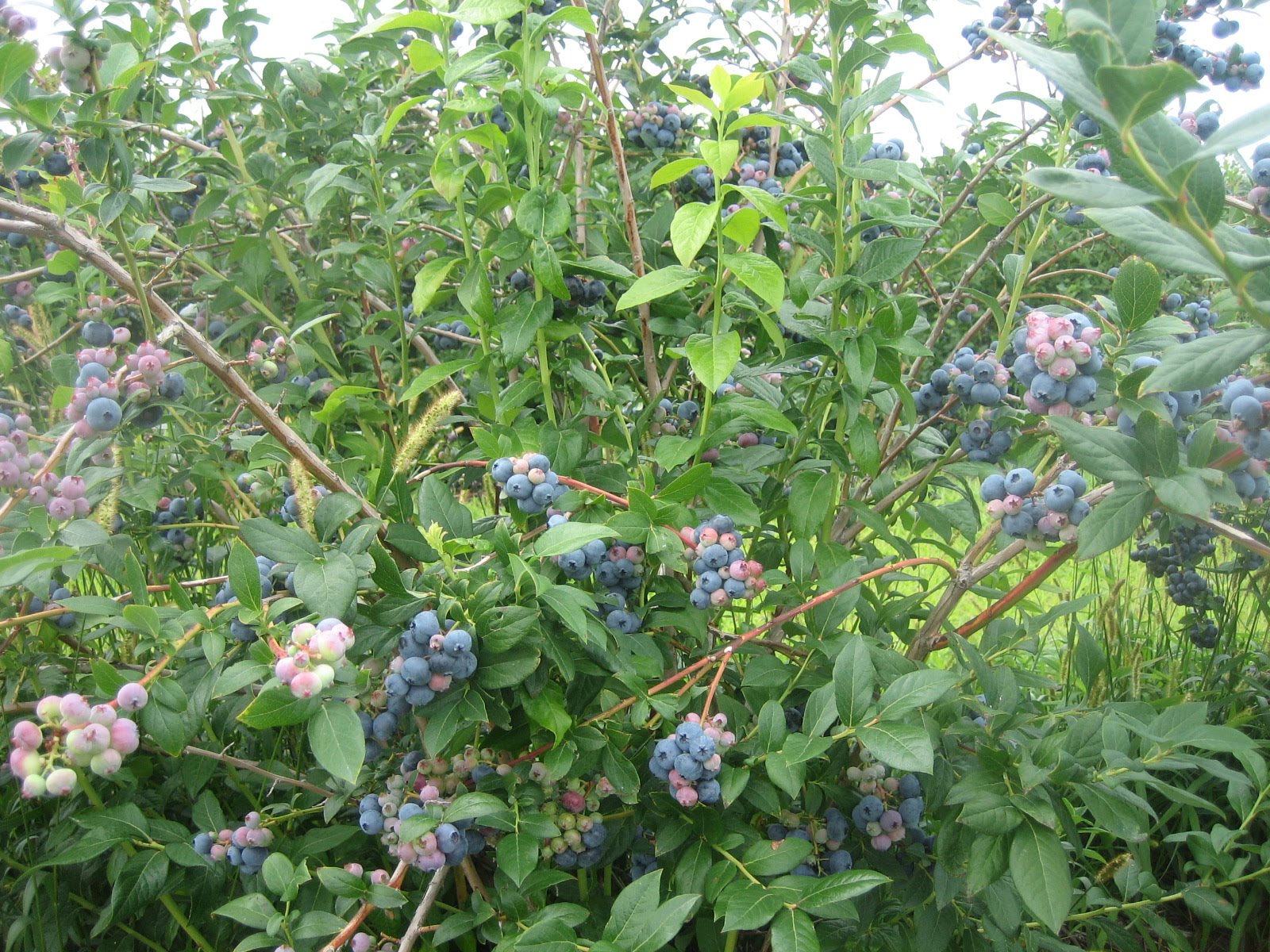
While raspberries are my favourite berry to eat straight off the bush / out of the basket, I have to admit that blueberries are far easier to pick.


See how the berries are just hanging there, out in the open, right at the outer edges of the bush? Not tucked behind foliage close to the centre stalk.


Notice, too, how they grow in huge clumps, just like grapes, further facilitating the picking process. It was almost too easy... but I'm not complaining.


While you can't really tell how tall the bushes are from this picture, trust me when I say they are the perfect height for picking. You can stand up straight (no lower back strain from slightly bending over to reach the berries at the centre of the bush) and harvest the top half of a given bush, then sit down on an inverted bucket to lazily pluck an even greater number of berries from the lower branches. I filled a 4-litre basket in just over one hour from a single bush!


These gems are sometimes referred to as "superfoods": not only are they rich in vitamins and essential nutrients, the blueberry is touted as the antioxidant superhero of the fruit world. Check out this summary of research on its disease-fighting properties. You may also be interested in reading what Dr. Joe Schwarcz has to say about blueberries keeping your brain healthy.

Meanwhile, attempt to live vicariously through me, because while the following pictures of pie (and little tarts made from leftover crust and filling, lovingly baked by my partner) look fantastic, technology has not evolved far enough to allow you to taste anything through the internet. In other words, please do not lick your monitor!


Saturday, July 31, 2010

CSAs: Part of Healthy Diet

What happens when you mix heirloom plants, fertile urban gardens, high heat on sunny days (interspersed with short-lived but heavy rain showers), and lots of hard work from dedicated farmers?


A gorgeous crop of fruit and vegetables grown no farther than a dozen or so km from where I live. All mine!

That's because I bought a share with the Young Urban Farmers (YUF) CSA (community shared agriculture) to be able to enjoy more tasty food than I can consume within a week for the rest of the growing season. Featured in this week's share were, in alphabetical order:
  • a blue jay bell pepper
  • cilantro
  • dill
  • an eggplant
  • flat-leaf parsley
  • ground cherries (in lantern-shaped husks)
  • hot peppers
  • kale
  • mixed salad greens
  • papaya pear squash
  • peas (too shy to pose for the picture)
  • peter pan squash
  • a plum
  • purple kohlrabi
  • radishes
  • swiss chard
  • thai basil
  • zucchini
Can you spot them all?

When I decided to join a CSA this year, I had some difficulty deciding which one to put my money behind. Luckily, I came across YUF and immediately fell in love with them: they grow their produce in city residents' backyards, not a suburban farm! Better yet, due to a lack of storage facilities, the crops are harvested no earlier than the night before I pick them up. And if that still doesn't convince you these folks are great, consider this: they specialize in heirloom and organic varieties that aren't available at the local grocery store or even farmers markets! That's more exclusive than the iPhone 4.

This summer, my weekly local food shares have challenged me to cook and prepare vegetables I previously could not even identify. What I've discovered is that for intimidating vegetables, simple methods work best: cut swiss chard into bite-sized pieces, then wilt in a pan with sautéed garlic, olive oil, salt, and pepper. I add a spritz of lemon juice when I'm feeling particularly adventurous. It's that easy! No wonder there are so many celebrity chefs on TV...

Community shared agriculture is an excellent idea because it benefits everyone involved: the "customers" receive very fresh, very local, organic food and pay about the same as they would in a grocery store, except they know the "who", "where", and "how" of the life cycle of the produce. Also, shareholders are supporting the local economy, help to maintain land used for agriculture rather than urban sprawl, and get to learn about how food is grown and when it is in season (this is especially vital for children living in the city).

Meanwhile, the farmers gain from this system by making a living without having to share profits with distributors. By receiving in the spring the budget they need to carry them through the whole season, producers can focus on the farm and the quality of the crops they are growing. Furthermore, the direct relationship they have with shareholders fosters a sense of responsibility and pride in their work. Even the land itself benefits! CSAs use sustainable farming practices, and in the case of YUF, areas that were previously unused (resident's grass-covered backyards) are transformed into productive land.

While I look up a recipe to make use of that purple kohlrabi from this week's share, check out the links below that will help you source a CSA in your area and find out more about how you can support ecologically sound and socially equitable agriculture.
Happy eating.

Sunday, July 25, 2010

Local, fresh, delicious... need I say more?

I think we need a new word to describe produce so local that it doesn't even travel one city block from harvest to kitchen. The equivalent of local-squared, only way more catchy!


Yup, that's a garden bed chock full of basil, a number of varieties of it, actually - that's purple basil up in front, looking and smelling so good that I had to restrain myself from tasting a few leaves. Which is saying a lot, considering I was completely stuffed after enjoying a lovely afternoon tea some twelve floors beneath this garden, in the Library Bar on the lobby level of the Royal York Hotel. Look a bit more closely at the picture and you'll soon notice that my friends and I were standing on the hotel's lower rooftop, right downtown, only a stone's throw away from other skyscrapers and condos. After the tea service, we were treated to a tour (guided by an apprentice chef, no less) of the hotel's herb garden and were pleasantly surprised to find more than just herbs:


Bees are easily one of my favourite insects (but I have to admit it's not hard to top that list when I have a fear-bordering-on-phobia of spiders and centipedes) due to their multi-tasking role in pollinating our crops and allowing us to repeatedly steal their honey. Also, they're cute and have never stung me. Bonus! So, upon seeing this collection of beehives, I was certainly delighted, then impressed when our guide explained that these bees not only help fertilize the plants in the herb garden, they are also known to fly as far as the Toronto Islands (3km away) to collect nectar from the wildflowers that grow there. Now that's a strong work ethic...

But wait, there's more:


It's hard to describe what heirloom varieties of tomatoes taste like compared to the random, no-name tomatoes you typically find in a grocery store. Basically... more tomato-y. These are the ones I often can't even be bothered to cut into a salad, because I'd rather just eat them whole, no dressing or salt required. The ones pictured here are pear tomatoes, which is fairly obvious from their shape. They had some other heirloom varieties that I didn't immortalize with my camera because they weren't ripe yet, but I'm guessing with more sun and heat in the forecast, it won't be long before they are served to some very lucky hotel guests. Jealous!

There were lots of other goodies on the roof, including way more herbs than I could identify, squash, edible flowers, and grapes:


Just before leaving, I was pleasantly surprised to find so much mint that just walking past it freshened my breath:


They're even cultivating a chocolate mint variety that, just as the name claims, tastes like chocolate! If you stop to think about that, it makes no sense. Mint that tastes like cocoa would be unlikely but somehow more naturally-occurring than mint that tastes like a human creation. But I'm not complaining!

The existence of this garden, and the knowledge that others like it are popping up all over the place, makes me very hopeful for the future. Although it may be unfeasible to grow enough produce on rooftops to feed an entire city, this is a start, and even if we can't all eat the meals created with this urban harvest, everybody benefits from green spaces on top of buildings: green roofs absorb heat and filter the air, reducing both smog and the urban heat island effect.

So let's hear it for downtown rooftop gardening! I raise a toast with my cup of tea.