I'm delighted to announce that my fellow blogger Lynn Fang over at Upcycled Love, crusader for social change, has just published an e-book!
Lynn, a strong supporter of environmental and social justice, loves to write about how we can change the world by making changes in our own lives. She discusses organic food and farming, DIY projects, conscious living, and other topics that help us value time, experiences, health, and happiness, rather than money, stuff, convenience, and productivity. In her never-ending search for creative ways to bring about change, Lynn asked her blogging friends for stories about successfully influencing others to adopt more sustainable lifestyle habits. By bringing together these stories into a collection of positive, empowering, hopeful anecdotes, Lynn has painted a picture of what works and what doesn't when trying to inspire others, and, overwhelmingly, it seems the best method is to act as a role model, to live life as sustainably and fully as possible, and to show that there is an alternative to the rat race that we're told to believe is the only way to live life. I was honoured to be able to contribute to Lynn's work, and I hope you will feel enlightened when reading this uplifting collection of stories. To download a free copy of the e-book, please click here.
Showing posts with label sustainability. Show all posts
Monday, December 5, 2011
Monday, October 31, 2011
Tuna: Big Fish, Big Problem
It's Hallowe'en tonight, so I thought it appropriate to tell you a horror story of sorts. For many years, I've been unhappy about how much damage is being done by the fishing industry; this is an often overlooked topic because when we think of food production we think of farms first. The problems with fishing bother me so much that I wrote about them within a few days of starting this blog! A few months ago I also explored the issue of mercury contamination in big fish. Needless to say, these days I'm quite picky when it comes to my consumption of fish and seafood, and I'm always on the lookout for more information and news. So today I give you four sad truths about the canned tuna industry (originally published by Grist) in hopes that we will all make smarter choices on our next trip to the supermarket.
1. Fish Aggregating Devices
These contraptions are appropriately named because they manage to attract a lot of fish to one area, making their capture almost insultingly easy. It turns out that fish aggregating devices, or FADs, are almost like ecosystem creators: a fishing vessel will drop a big floating object onto the surface of the ocean, leave it behind with a radio beacon for later retrieval, and soon enough small plants root themselves onto the object, which attract small fish seeking a hiding place, which attract larger fish seeking a food source. Tuna in particular love to hang around beneath this floating world of activity. And so it comes to pass that fishing vessels net entire schools of skipjack tuna... but the FAD also gives them sharks, dolphins, other fish, and juvenile yellowfin and bigeye tuna. In other words, two types of tuna that are already disappearing at an alarming rate now face an even greater challenge because we're killing their young before they've had a chance to breed. Just so that we can spend no more than a couple of bucks on a can of skipjack tuna. What a teensy price to help bring animals closer to extinction!
2. Longlines
What matters about longlines aren't that the lines sometimes stretch as far as a few miles between buoys, but rather that the leads dangling from the main line have baited hooks attached at the end. As with FADs, longlines catch more than they should. Instead of reeling in only albacore tuna, the typical variety found in cans marked "white tuna", fishing vessels will find a bycatch of turtles, albatross, sharks, and numerous sea birds attracted to the shiny metal of the hooks and the food dangling from them. Shockingly, the non-targeted animals killed by longlines account for about 30% of the catch! I can't think of any other industry in which such a large margin for error is tolerated. And it's not just error, it's unnecessary death. I guess the albacore fishing industry makes so much money that it just doesn't matter.
3. The Wild West on the High Seas
Every island nation in the Pacific is entitled to an exclusive economic zone (EEZ) in the sea, in which limits are set on how much fish may be caught. In order to manage tuna stocks sustainably, countries must be able to impose and enforce strict quotas, otherwise all ocean wildlife will be fished until there is nothing left. What is a greedy company to do to make more money? Set sail for the high seas pockets outside of the the 200-mile boundaries of neighbouring island states' EEZs. These pockets are unregulated and unpatrolled, allowing fishing vessels to net as many fish as they'd like without having to stay within a maximum limit and without having to pay any fees to the nearby countries. The companies multiply their profit margin, the fish stocks get decimated, the Pacific nations are stuck with less healthy and robust tuna stocks that they must manage with less money. The fishing companies win, and everybody else loses.
4. Social Injustice
To add insult to injury, the Pacific island states that can't afford to defend their waters fall victim to bullies: large, wealthy nations like Taiwan, Spain, and the United States in conjunction with tuna corporations that lack an ethical code. Their fishing vessels literally take what isn't theirs inside of these nations' EEZs with no regard whatsoever for the desperate need of islanders to make a living off of tuna, as it is their only resource. In response to this bullying, some of the Pacific island states have decided to join forces to better defend themselves and maintain their tuna stocks. This new collaborative is called the Parties to the Nauru Agreement (PNA), and it involves Micronesia, Kiribati, the Marshall Islands, Nauru, Palau, Papua New Guinea, the Solomon Islands, and Tuvalu. 25-30% of global tuna stocks are managed within the EEZs of these eight states, so there is a lot to lose if the Nauru Agreement isn't better supported by fishing companies.
What Can You Do?
Image of yellowfin tuna used under Creative Commons from Roro Fernandez (flickr).
Image of albatross used under Creative Commons from marj k (flickr).
Image of fishing vessel/coast guard used under Creative Commons from Coast Guard News (flickr).
Image of pirate flag used under Creative Commons from Chris Evans (drumminhands/flickr).
1. Fish Aggregating Devices
These contraptions are appropriately named because they manage to attract a lot of fish to one area, making their capture almost insultingly easy. It turns out that fish aggregating devices, or FADs, are almost like ecosystem creators: a fishing vessel will drop a big floating object onto the surface of the ocean, leave it behind with a radio beacon for later retrieval, and soon enough small plants root themselves onto the object, which attract small fish seeking a hiding place, which attract larger fish seeking a food source. Tuna in particular love to hang around beneath this floating world of activity. And so it comes to pass that fishing vessels net entire schools of skipjack tuna... but the FAD also gives them sharks, dolphins, other fish, and juvenile yellowfin and bigeye tuna. In other words, two types of tuna that are already disappearing at an alarming rate now face an even greater challenge because we're killing their young before they've had a chance to breed. Just so that we can spend no more than a couple of bucks on a can of skipjack tuna. What a teensy price to help bring animals closer to extinction!
2. Longlines
What matters about longlines aren't that the lines sometimes stretch as far as a few miles between buoys, but rather that the leads dangling from the main line have baited hooks attached at the end. As with FADs, longlines catch more than they should. Instead of reeling in only albacore tuna, the typical variety found in cans marked "white tuna", fishing vessels will find a bycatch of turtles, albatross, sharks, and numerous sea birds attracted to the shiny metal of the hooks and the food dangling from them. Shockingly, the non-targeted animals killed by longlines account for about 30% of the catch! I can't think of any other industry in which such a large margin for error is tolerated. And it's not just error, it's unnecessary death. I guess the albacore fishing industry makes so much money that it just doesn't matter.
3. The Wild West on the High Seas
Every island nation in the Pacific is entitled to an exclusive economic zone (EEZ) in the sea, in which limits are set on how much fish may be caught. In order to manage tuna stocks sustainably, countries must be able to impose and enforce strict quotas, otherwise all ocean wildlife will be fished until there is nothing left. What is a greedy company to do to make more money? Set sail for the high seas pockets outside of the the 200-mile boundaries of neighbouring island states' EEZs. These pockets are unregulated and unpatrolled, allowing fishing vessels to net as many fish as they'd like without having to stay within a maximum limit and without having to pay any fees to the nearby countries. The companies multiply their profit margin, the fish stocks get decimated, the Pacific nations are stuck with less healthy and robust tuna stocks that they must manage with less money. The fishing companies win, and everybody else loses.
4. Social Injustice
To add insult to injury, the Pacific island states that can't afford to defend their waters fall victim to bullies: large, wealthy nations like Taiwan, Spain, and the United States in conjunction with tuna corporations that lack an ethical code. Their fishing vessels literally take what isn't theirs inside of these nations' EEZs with no regard whatsoever for the desperate need of islanders to make a living off of tuna, as it is their only resource. In response to this bullying, some of the Pacific island states have decided to join forces to better defend themselves and maintain their tuna stocks. This new collaborative is called the Parties to the Nauru Agreement (PNA), and it involves Micronesia, Kiribati, the Marshall Islands, Nauru, Palau, Papua New Guinea, the Solomon Islands, and Tuvalu. 25-30% of global tuna stocks are managed within the EEZs of these eight states, so there is a lot to lose if the Nauru Agreement isn't better supported by fishing companies.
What Can You Do?
- If you're looking for light tuna, make sure it's labelled as pole-and-line or FAD-free skipjack.
- If white tuna is on your grocery list, what you'll want is the pole-and-line albacore variety.
- Support companies that make it a point to avoid fishing in the high seas pockets.
- Buy only from companies that publicly support the Parties to the Nauru Agreement (PNA).
Image of yellowfin tuna used under Creative Commons from Roro Fernandez (flickr).
Image of albatross used under Creative Commons from marj k (flickr).
Image of fishing vessel/coast guard used under Creative Commons from Coast Guard News (flickr).
Image of pirate flag used under Creative Commons from Chris Evans (drumminhands/flickr).
Friday, October 14, 2011
Constructive Criticism
Two weeks ago I told you about the 12th annual Planet in Focus environmental film festival taking place this week in Toronto. On Wednesday I had the honour of chaperoning Chris Paine, Director of Revenge of the Electric Car, at the Opening Night Gala (to make sure he knew where and when to meet with interviewers, walk the green carpet, and watch the Canadian premiere of his film). Since then I've also lent a hand to Industry Series programming and taken in my share of screenings. What I truly love about helping at the festival is meeting other volunteers, especially those who open my eyes to issues that I hadn't previously considered.
Which brings me to Roberto: he's a student from Chile currently on exchange taking courses in Ryerson's Film Studies program. He and his friend are trying to put together an environmental film festival of their own back home, which is no small feat for two kids in their early 20s. What I wasn't expecting to hear from him is that in addition to featuring films that cover green topics, he hopes to make the festival itself as eco-friendly as possible - and not just greenwash it.
Don't get me wrong, Planet in Focus is getting some things right. VIP Directors, including Mr. Paine and his two guests, were brought to the festival from the airport by green taxi (in other words, in a hybrid Prius). Also, anyone attending the Opening Night Gala and coming on two wheels was treated to a complimentary bike valet. And the two venues at which the screenings are being held are walking distance apart. But sometimes it's the little things that betray either a lack of planning or a disinterest in going the extra mile.
Take the Green Networking Lounge, for example. This event reminds me of speed-dating, where filmmakers get fifteen minutes to chat one-on-one with funders, commissioning editors, and other film and television executives. The festival provided coffee, water, and an assortment of muffins for this event. What was missing? Unlike last year, there were no real plates, real mugs, or real cutlery (instead: countless paper cups, napkins, and stir-sticks). The only concern seemed to be to avoid handing out plastic water bottles. Not that I disagree with that guideline, but it's only a starting point. This is an environmental film festival, after all.
Roberto, bless his young and ambitious heart, wants to see if it's possible to screen films at his festival using stationary bike power. Perhaps we don't need to go quite so far. I'm being a little nit-picky about the finer details and ought to point out that Planet in Focus bought carbon and green energy offsets, which is actually a pretty big deal. And the foodie in me was really happy to see organic milk in glass bottles alongside the coffee! To be completely honest, what motivated this post was the difficulty I'm experiencing in reconciling the fact that in order to bring awareness to the public of issues afflicting the world, film crews have to fly around the globe a few times and then take even more plane trips to tour with their documentaries, and then we sit and watch these films under less than ideal circumstances. I guess for now I have to suck it up and hope that spreading the word about the kinds of issues covered this week is more important than the carbon footprint of filmmaking - and the greenness of the festival itself.
Photo of box office used under Creative Commons from Rae Allen (flickr).
Photo of live music powered by bike used under Creative Commons from Earthnwork (flickr).
Which brings me to Roberto: he's a student from Chile currently on exchange taking courses in Ryerson's Film Studies program. He and his friend are trying to put together an environmental film festival of their own back home, which is no small feat for two kids in their early 20s. What I wasn't expecting to hear from him is that in addition to featuring films that cover green topics, he hopes to make the festival itself as eco-friendly as possible - and not just greenwash it.
Don't get me wrong, Planet in Focus is getting some things right. VIP Directors, including Mr. Paine and his two guests, were brought to the festival from the airport by green taxi (in other words, in a hybrid Prius). Also, anyone attending the Opening Night Gala and coming on two wheels was treated to a complimentary bike valet. And the two venues at which the screenings are being held are walking distance apart. But sometimes it's the little things that betray either a lack of planning or a disinterest in going the extra mile.
Take the Green Networking Lounge, for example. This event reminds me of speed-dating, where filmmakers get fifteen minutes to chat one-on-one with funders, commissioning editors, and other film and television executives. The festival provided coffee, water, and an assortment of muffins for this event. What was missing? Unlike last year, there were no real plates, real mugs, or real cutlery (instead: countless paper cups, napkins, and stir-sticks). The only concern seemed to be to avoid handing out plastic water bottles. Not that I disagree with that guideline, but it's only a starting point. This is an environmental film festival, after all.
Roberto, bless his young and ambitious heart, wants to see if it's possible to screen films at his festival using stationary bike power. Perhaps we don't need to go quite so far. I'm being a little nit-picky about the finer details and ought to point out that Planet in Focus bought carbon and green energy offsets, which is actually a pretty big deal. And the foodie in me was really happy to see organic milk in glass bottles alongside the coffee! To be completely honest, what motivated this post was the difficulty I'm experiencing in reconciling the fact that in order to bring awareness to the public of issues afflicting the world, film crews have to fly around the globe a few times and then take even more plane trips to tour with their documentaries, and then we sit and watch these films under less than ideal circumstances. I guess for now I have to suck it up and hope that spreading the word about the kinds of issues covered this week is more important than the carbon footprint of filmmaking - and the greenness of the festival itself.
Photo of box office used under Creative Commons from Rae Allen (flickr).
Photo of live music powered by bike used under Creative Commons from Earthnwork (flickr).
Wednesday, September 7, 2011
When environmentalism meets slow living... and they don't get along...
I am a letter-writer, hear me roar! Or hear the scrape of my fountain pen against paper, as it were...
This week I received a letter in the mail, one I had written and sent to Australia and which was subsequently returned to me because the recipient had moved and informed me of her new address only after the mail was already on its way to the other side of the world. And so a few pieces of paper and an envelope found themselves travelling 16,000 km (10,000 miles) only to be labelled with a "return to sender" scribble and sent back that same distance to my door. Let me tell you, a lot of guilt was delivered by mail that day!
Except... I'm not so sure. On the one hand, paper stationery kills trees, ink is made of petroleum and other toxic chemicals, and planes emit a great deal of emissions. On the other hand, even if I could stop using paper altogether for the rest of my life, forests would still die at the hands of big corporations and their printers' endless appetite for reams of paper, not to mention the pulp and lumber industries. Even if I gave up ball-point and fountain pens, every last drop of petroleum will eventually be extracted for fuel and military uses. And let's face it, there won't be fewer planes in the skies just because I stop mailing letters. The sad truth is that even if every last proud letter-writer like me gave up their hobby, not much would change on the global scale.
Unfortunately such rationalization doesn't make the guilt disappear. I still hold sustainability ideals close to my heart and feel the need to do as much as I can, within reason, to lessen my carbon footprint. The strange thing is that my desire to live simply and slowly occasionally gets in the way of my environmental goals, like in this case. Usually my attempts at taking breaks from the fast pace of life - cooking seasonal meals with locally grown ingredients at home, unplugging from the internet over the weekend, getting up early to walk all the way to work, etc. - conveniently satisfy my urge to live green. Writing letters, it seems, helps with the former and impedes the latter. Sitting down with a cup of tea in my left hand and a fountain pen in my right hand to share my recent life experiences with a far-away friend is a lovely experience, and not something easily accomplished using an electronic, environmentally friendly method. And so I sacrifice the planet ever so slightly for the sake of my well-being, which I hope is the right trade-off.
What do you do that lets you live slowly but isn't as green as you'd like?
Photo of fountain pen used under Creative Commons from Adrian Clark (a.drian/flickr).
Photo of air mail stickers used under Creative Commons from Katey Nicosia (flickr).
This week I received a letter in the mail, one I had written and sent to Australia and which was subsequently returned to me because the recipient had moved and informed me of her new address only after the mail was already on its way to the other side of the world. And so a few pieces of paper and an envelope found themselves travelling 16,000 km (10,000 miles) only to be labelled with a "return to sender" scribble and sent back that same distance to my door. Let me tell you, a lot of guilt was delivered by mail that day!
Except... I'm not so sure. On the one hand, paper stationery kills trees, ink is made of petroleum and other toxic chemicals, and planes emit a great deal of emissions. On the other hand, even if I could stop using paper altogether for the rest of my life, forests would still die at the hands of big corporations and their printers' endless appetite for reams of paper, not to mention the pulp and lumber industries. Even if I gave up ball-point and fountain pens, every last drop of petroleum will eventually be extracted for fuel and military uses. And let's face it, there won't be fewer planes in the skies just because I stop mailing letters. The sad truth is that even if every last proud letter-writer like me gave up their hobby, not much would change on the global scale.
Unfortunately such rationalization doesn't make the guilt disappear. I still hold sustainability ideals close to my heart and feel the need to do as much as I can, within reason, to lessen my carbon footprint. The strange thing is that my desire to live simply and slowly occasionally gets in the way of my environmental goals, like in this case. Usually my attempts at taking breaks from the fast pace of life - cooking seasonal meals with locally grown ingredients at home, unplugging from the internet over the weekend, getting up early to walk all the way to work, etc. - conveniently satisfy my urge to live green. Writing letters, it seems, helps with the former and impedes the latter. Sitting down with a cup of tea in my left hand and a fountain pen in my right hand to share my recent life experiences with a far-away friend is a lovely experience, and not something easily accomplished using an electronic, environmentally friendly method. And so I sacrifice the planet ever so slightly for the sake of my well-being, which I hope is the right trade-off.What do you do that lets you live slowly but isn't as green as you'd like?
Photo of fountain pen used under Creative Commons from Adrian Clark (a.drian/flickr).
Photo of air mail stickers used under Creative Commons from Katey Nicosia (flickr).
Tuesday, August 16, 2011
Rapunzel, Rapunzel, Let Down Your Hair
I'll cut right to the chase for those of you who are confused by the title of this post. I was thinking in the shower this morning that the water I use to wet and rinse my hair when washing it makes up the vast majority of the water I use when I bathe, and this made me wonder whether choosing to keep it long is an environmentally unfriendly act.
Unlike Rapunzel, my hair isn't blonde, and compared to her, I have nothing to complain about when it comes to keeping my mane tamed. There's a reason they don't show her washing and drying her hair in last year's Tangled animated movie: it would have eaten up half of the running time! Still, my hair is thick and long (down to the middle/small of my back, and not layered), at least by non-fairy tale standards, and because I've used conventional hair products so sparingly over the years and only ever dyed my hair once, it's in very good condition. Since it suits me at this length, there's simply no need to change my hair style. Until I consider the water and energy waste involved in maintaining it!
This summer I've been really good with turning off the shower while I lather shampoo into my hair, but rinsing it and the occasional conditioner out requires a lot of water, especially since my hair is so thick. My showers seem to take forever! On days when I don't need to wash my hair (thankfully, two days out of three) I can zip in and out of the shower in a minute or two. Hair washing days... I'd rather not admit how long I spend under the running water.
Then there's the drying. I'm happy to let the heat and sun of the summer take care of that, but it's just not an option in colder weather. A hair dryer is necessary so I don't freeze to death in the winter, and I don't think those gadgets come in energy efficient models. Even so, it takes 20-25 minutes to get my hair completely dry. Please don't make me calculate the kW use associated with that process two to three times a week!
The question is, should my environmental ideals trump my aesthetic ideals? Maybe my long hair isn't an aesthetic ideal as much as a vanity-driven obsession. After all, the more often I am complimented for my hair, the bigger my ego gets. In that case, taking the plunge and opting for a very short hair style for green reasons seems acceptable and potentially good for my modesty. If I'm already the type of person who doesn't wear make-up, rarely accessorizes my wardrobe with matching jewellery, and almost never applies polish to my nails, why put so much importance on my hair? On the other hand, this feels like a pretty drastic move.
I'm stumped - what should I do?
Photo of Rapunzel doll used under Creative Commons from Jenny (jollyserenity27/flickr).
Photo of long hair being cut used under Creative Commons from alachia (flickr).
Unlike Rapunzel, my hair isn't blonde, and compared to her, I have nothing to complain about when it comes to keeping my mane tamed. There's a reason they don't show her washing and drying her hair in last year's Tangled animated movie: it would have eaten up half of the running time! Still, my hair is thick and long (down to the middle/small of my back, and not layered), at least by non-fairy tale standards, and because I've used conventional hair products so sparingly over the years and only ever dyed my hair once, it's in very good condition. Since it suits me at this length, there's simply no need to change my hair style. Until I consider the water and energy waste involved in maintaining it!
This summer I've been really good with turning off the shower while I lather shampoo into my hair, but rinsing it and the occasional conditioner out requires a lot of water, especially since my hair is so thick. My showers seem to take forever! On days when I don't need to wash my hair (thankfully, two days out of three) I can zip in and out of the shower in a minute or two. Hair washing days... I'd rather not admit how long I spend under the running water.
Then there's the drying. I'm happy to let the heat and sun of the summer take care of that, but it's just not an option in colder weather. A hair dryer is necessary so I don't freeze to death in the winter, and I don't think those gadgets come in energy efficient models. Even so, it takes 20-25 minutes to get my hair completely dry. Please don't make me calculate the kW use associated with that process two to three times a week!
The question is, should my environmental ideals trump my aesthetic ideals? Maybe my long hair isn't an aesthetic ideal as much as a vanity-driven obsession. After all, the more often I am complimented for my hair, the bigger my ego gets. In that case, taking the plunge and opting for a very short hair style for green reasons seems acceptable and potentially good for my modesty. If I'm already the type of person who doesn't wear make-up, rarely accessorizes my wardrobe with matching jewellery, and almost never applies polish to my nails, why put so much importance on my hair? On the other hand, this feels like a pretty drastic move.
I'm stumped - what should I do?
Photo of Rapunzel doll used under Creative Commons from Jenny (jollyserenity27/flickr).
Photo of long hair being cut used under Creative Commons from alachia (flickr).
Friday, August 12, 2011
Friday Feel Good News
It's Friday, and in my books, that means it's time to feel good. Let's set aside the doom-and-gloom stories for a moment and focus on some good news!
--------------------
This week I kept putting off preparing this Friday Feel Good News post because so many happy stories came my way that it was hard to decide which to tell you about. I'm savouring this experience because it will no doubt be short-lived! So without further delay, let's learn about the sustainable vision behind Squishy Press publishing company.
As every parent knows, babies like chewing on books! Parents Allison Reeve Manley and Rob Coleman decided they wanted to do something about that - they knew they couldn't prevent their son from putting books in his mouth, but they wanted to make sure he wasn't being harmed in the process. Think about all of the products on the market for children these days that are available in safe and non-toxic varieties, from organic cotton clothing to BPA-free bottles. What's missing? Books without harsh chemicals in the binding, ink, and laminate.
It was an obvious move, then, for Manley and Coleman to use their design expertise to create safe books that contain significantly lower levels of toxins than the national requirement. The first title to be printed was Opposites, which teaches kids about antonyms such as happy vs. sad and wet vs. dry using images of children depicting those states (which is, in my humble opinion, brilliant), followed by Silly Faces, which as you can imagine is filled with photos of kids making silly faces! Manley is working on creating four more books along the same vein and expanding her company's merchandise line to include stacking blocks, puzzles, and memory games.
For those of you who care about all things green but don't have little ones in your life, how cool is it that Squishy Press produces its books at wind-powered facilities using recycled paper, with all materials manufactured in the US? There's lots to love about this publishing company that has already sold 4,000 books in one year. For more information, please visit the Squishy Press website or check out Manley's profile in the Washington University in St. Louis magazine, which is where I read about this great story after my WUSTL alumni friend sent me the link! Thanks Angini and happy Feel Good News Friday to all!
Photo of baby chewing book used under Creative Commons from Jody Morris (JodyDigger/flickr).
Photo of wind farm used under Creative Commons from Jeff Kubina (flickr).
--------------------
This week I kept putting off preparing this Friday Feel Good News post because so many happy stories came my way that it was hard to decide which to tell you about. I'm savouring this experience because it will no doubt be short-lived! So without further delay, let's learn about the sustainable vision behind Squishy Press publishing company.
As every parent knows, babies like chewing on books! Parents Allison Reeve Manley and Rob Coleman decided they wanted to do something about that - they knew they couldn't prevent their son from putting books in his mouth, but they wanted to make sure he wasn't being harmed in the process. Think about all of the products on the market for children these days that are available in safe and non-toxic varieties, from organic cotton clothing to BPA-free bottles. What's missing? Books without harsh chemicals in the binding, ink, and laminate.
It was an obvious move, then, for Manley and Coleman to use their design expertise to create safe books that contain significantly lower levels of toxins than the national requirement. The first title to be printed was Opposites, which teaches kids about antonyms such as happy vs. sad and wet vs. dry using images of children depicting those states (which is, in my humble opinion, brilliant), followed by Silly Faces, which as you can imagine is filled with photos of kids making silly faces! Manley is working on creating four more books along the same vein and expanding her company's merchandise line to include stacking blocks, puzzles, and memory games.
For those of you who care about all things green but don't have little ones in your life, how cool is it that Squishy Press produces its books at wind-powered facilities using recycled paper, with all materials manufactured in the US? There's lots to love about this publishing company that has already sold 4,000 books in one year. For more information, please visit the Squishy Press website or check out Manley's profile in the Washington University in St. Louis magazine, which is where I read about this great story after my WUSTL alumni friend sent me the link! Thanks Angini and happy Feel Good News Friday to all!
Photo of baby chewing book used under Creative Commons from Jody Morris (JodyDigger/flickr).
Photo of wind farm used under Creative Commons from Jeff Kubina (flickr).
Monday, August 1, 2011
How to Retreat From the City
A week ago I quietly slipped away from the world to spend five days at Sugar Ridge Retreat Centre. Staying true to my wish from last year to escape to a cabin in the woods, this is what the view is like looking south from the retreat centre:
Those are two of ten cabins that surround the centre where up to four people can sleep to the sound of cicadas and wake to the sound of bird song. Having made plans to stay at the centre separately from any pre-packaged, group retreat program, I got an entire cabin to myself. For the greatest amount of privacy and peace and quiet, I was placed in cabin 3, which is located farthest from the centre. You can just barely see the red roof in the centre of this photo because the cabin is nestled right into the forest:
I spent my week taking in the scenery, writing in my journal, and doing a whole lot of nothing. I broke up the days attending yoga and meditation classes in a gorgeous studio that featured round walls, large windows to let in plenty of natural light, mandalas painted onto the walls, and a domed ceiling:
The only disruption to this relaxing experience were the mosquitoes. I was using DEET-free Druide organic insect repellent that smelled strongly of citronella and worked like a charm... until it wore off in the middle of the night and the bugs trapped inside my cabin feasted on my exposed skin! I am happy to state that not a single deer fly managed to bite a chunk of flesh out of me, and my mosquito bites are no longer itchy, so all is well.
I look forward to returning to Sugar Ridge in the fall, when the colours turn, and again in the early spring in time for maple syrup season, as the centre was built within a sugar maple forest that is tapped for sap every year. I'm also a big fan of the environmental aspects of the centre, such as the straw-bale walls of the yoga studio, low-flow toilets, washroom lights running on motion sensors, high efficiency windows, ample use of compost bins, and a focus on local and organic food. Click here for the complete list of environmental practices.
Have you been away this summer? Were you able to make your vacation relatively green?
Those are two of ten cabins that surround the centre where up to four people can sleep to the sound of cicadas and wake to the sound of bird song. Having made plans to stay at the centre separately from any pre-packaged, group retreat program, I got an entire cabin to myself. For the greatest amount of privacy and peace and quiet, I was placed in cabin 3, which is located farthest from the centre. You can just barely see the red roof in the centre of this photo because the cabin is nestled right into the forest:
I spent my week taking in the scenery, writing in my journal, and doing a whole lot of nothing. I broke up the days attending yoga and meditation classes in a gorgeous studio that featured round walls, large windows to let in plenty of natural light, mandalas painted onto the walls, and a domed ceiling:
The only disruption to this relaxing experience were the mosquitoes. I was using DEET-free Druide organic insect repellent that smelled strongly of citronella and worked like a charm... until it wore off in the middle of the night and the bugs trapped inside my cabin feasted on my exposed skin! I am happy to state that not a single deer fly managed to bite a chunk of flesh out of me, and my mosquito bites are no longer itchy, so all is well.
I look forward to returning to Sugar Ridge in the fall, when the colours turn, and again in the early spring in time for maple syrup season, as the centre was built within a sugar maple forest that is tapped for sap every year. I'm also a big fan of the environmental aspects of the centre, such as the straw-bale walls of the yoga studio, low-flow toilets, washroom lights running on motion sensors, high efficiency windows, ample use of compost bins, and a focus on local and organic food. Click here for the complete list of environmental practices.
Have you been away this summer? Were you able to make your vacation relatively green?
Friday, July 22, 2011
How to Be Wasteful: Grow a Grass Lawn
It was a few weeks ago, over the holiday long weekend at the start of the month, when I started thinking about writing a post on the topic of grass lawns. My mother told me she had heard that we have President Roosevelt to thank for introducing British style lawns to the US. He was apparently very impressed with how neat and tidy English golf lawns looked. However...
... this is what lawns look like in my neck of the woods these days (and I've seen much worse). After an unseasonably rainy spring, we've had an unseasonably dry summer. Not only have we received very little precipitation, but I haven't seen a cloud in so long that I forget what they look like. Grass suffers in these conditions while it thrives in the damp of the British countryside. If only President Roosevelt had been surrounded by advisers with expertise in botany and climatology. Perhaps he could have been swayed to rethink the landscaping around the White House and grow lawns with grass alternatives and other types of ground cover more suitable for hot, dry conditions - homeowners would be mimicking a more sustainable landscaping strategy. But I'm getting ahead of myself.
Briefly, let's think about what makes grass lawns a bad idea. A lot of this will sound familiar to you if you read my post on golf courses last year. As I mentioned above, hot and dry weather stunts grass growth while promoting the proliferation of unwanted plants that think sunshine and dry soil are lovely. The common reaction is to kill weeds with pesticides and boost grass growth with fertilizer. Both are toxic, both are dependent on fossil fuels: that's a 1-2 punch to the environment's gut and our health. It gets worse when you factor in gas-powered mowers, some of which emit more pollution than cars. Weed whackers and leaf blowers are similarly hazardous. But my favourite lawn-related environmental no-no is the intensive use of water. When grass turns brown it's not dead, it's reducing its need for water! In the end, watering a brown lawn only makes matters worse by signalling the grass that it can return to its green, water-thirsty growth mode! My ultimate pet peeve is...
... lawns being watered at midday, when the sun is at its peak and evaporating mist and droplets before they even fall on the grass. I took this photo yesterday, on the hottest day of the summer. We actually broke a record for July with 37.5 C (100 F), which felt like the upper 40s (115-120 F) with humidity factored in. Note the wet stones and pavement, and how the grass is only receiving half of the water coming out of the sprinkler. I suspect the photo looks dark because my camera couldn't handle the brightness. I took this shot at 1 pm when the sun was directly overhead - everything but the porch was in full sun, at a UV level of 11, no less.
What are our options? With more hot and dry weather on the way for the foreseeable future (global climate change, anyone?), we are forced to focus on adapting. While some non-toxic pesticides and fertilizers do exist, including products you can put together at home, you'll still have to mow and water like everybody else. Switch to an electric mower and set its blade height to leave the grass longer. Be efficient with your sprinkler! Make sure the spray only reaches as far as the edge of your lawn (not the pavement beyond), water only in the early morning when the sun is low on the horizon and the air is somewhat cool, and keep the sprinkler going only as long as necessary.
For those of you who can make a bigger commitment, consider planting hardier varieties of grass that are suited to your region's climate. Add more trees to your property that keep your lawn in the shade. Experiment with drought-tolerant grass alternatives and extend your flower beds farther into your lawn to reduce the overall amount of grass on your property. Your local garden centre staff can tell you about ground cover alternatives, and if you can afford it, why not hire a landscaping company to do a complete makeover of your front yard and turn that lawn into a native plant habitat garden? Here's what that looks like in my neighbourhood:
My favourite solution is...
... putting that soil to good use and growing veggies, like in this front yard a few blocks from where I live. If the image looks fuzzy it's because my camera caught the high evening humidity from a few nights ago. Remember, every little bit counts. Choose the options that work for you and your living situation and run with them. We don't need award-winning botanical gardens in every yard!
Do you have any tips for sustainable landscaping?
... this is what lawns look like in my neck of the woods these days (and I've seen much worse). After an unseasonably rainy spring, we've had an unseasonably dry summer. Not only have we received very little precipitation, but I haven't seen a cloud in so long that I forget what they look like. Grass suffers in these conditions while it thrives in the damp of the British countryside. If only President Roosevelt had been surrounded by advisers with expertise in botany and climatology. Perhaps he could have been swayed to rethink the landscaping around the White House and grow lawns with grass alternatives and other types of ground cover more suitable for hot, dry conditions - homeowners would be mimicking a more sustainable landscaping strategy. But I'm getting ahead of myself.
Briefly, let's think about what makes grass lawns a bad idea. A lot of this will sound familiar to you if you read my post on golf courses last year. As I mentioned above, hot and dry weather stunts grass growth while promoting the proliferation of unwanted plants that think sunshine and dry soil are lovely. The common reaction is to kill weeds with pesticides and boost grass growth with fertilizer. Both are toxic, both are dependent on fossil fuels: that's a 1-2 punch to the environment's gut and our health. It gets worse when you factor in gas-powered mowers, some of which emit more pollution than cars. Weed whackers and leaf blowers are similarly hazardous. But my favourite lawn-related environmental no-no is the intensive use of water. When grass turns brown it's not dead, it's reducing its need for water! In the end, watering a brown lawn only makes matters worse by signalling the grass that it can return to its green, water-thirsty growth mode! My ultimate pet peeve is...
... lawns being watered at midday, when the sun is at its peak and evaporating mist and droplets before they even fall on the grass. I took this photo yesterday, on the hottest day of the summer. We actually broke a record for July with 37.5 C (100 F), which felt like the upper 40s (115-120 F) with humidity factored in. Note the wet stones and pavement, and how the grass is only receiving half of the water coming out of the sprinkler. I suspect the photo looks dark because my camera couldn't handle the brightness. I took this shot at 1 pm when the sun was directly overhead - everything but the porch was in full sun, at a UV level of 11, no less.
What are our options? With more hot and dry weather on the way for the foreseeable future (global climate change, anyone?), we are forced to focus on adapting. While some non-toxic pesticides and fertilizers do exist, including products you can put together at home, you'll still have to mow and water like everybody else. Switch to an electric mower and set its blade height to leave the grass longer. Be efficient with your sprinkler! Make sure the spray only reaches as far as the edge of your lawn (not the pavement beyond), water only in the early morning when the sun is low on the horizon and the air is somewhat cool, and keep the sprinkler going only as long as necessary.
For those of you who can make a bigger commitment, consider planting hardier varieties of grass that are suited to your region's climate. Add more trees to your property that keep your lawn in the shade. Experiment with drought-tolerant grass alternatives and extend your flower beds farther into your lawn to reduce the overall amount of grass on your property. Your local garden centre staff can tell you about ground cover alternatives, and if you can afford it, why not hire a landscaping company to do a complete makeover of your front yard and turn that lawn into a native plant habitat garden? Here's what that looks like in my neighbourhood:
My favourite solution is...
... putting that soil to good use and growing veggies, like in this front yard a few blocks from where I live. If the image looks fuzzy it's because my camera caught the high evening humidity from a few nights ago. Remember, every little bit counts. Choose the options that work for you and your living situation and run with them. We don't need award-winning botanical gardens in every yard!
Do you have any tips for sustainable landscaping?
Tuesday, July 19, 2011
Presenting... the New Cat Tree!
Back in April I wrote a post about cat trees, mainly to discourage everyone from buying the furniture for sale at pet stores. Traditional cat trees are often made from materials that harm you, your kittens, and the environment, such as wood that isn't harvested sustainably and manufactured into particleboard using formaldehyde glue or carpeting that is made from petroleum byproducts and covered in toxic stain-repellents. I went so far as to recommend four alternatives that are safer and cleaner, and three months later I followed my own advice and bought a new cat tree!
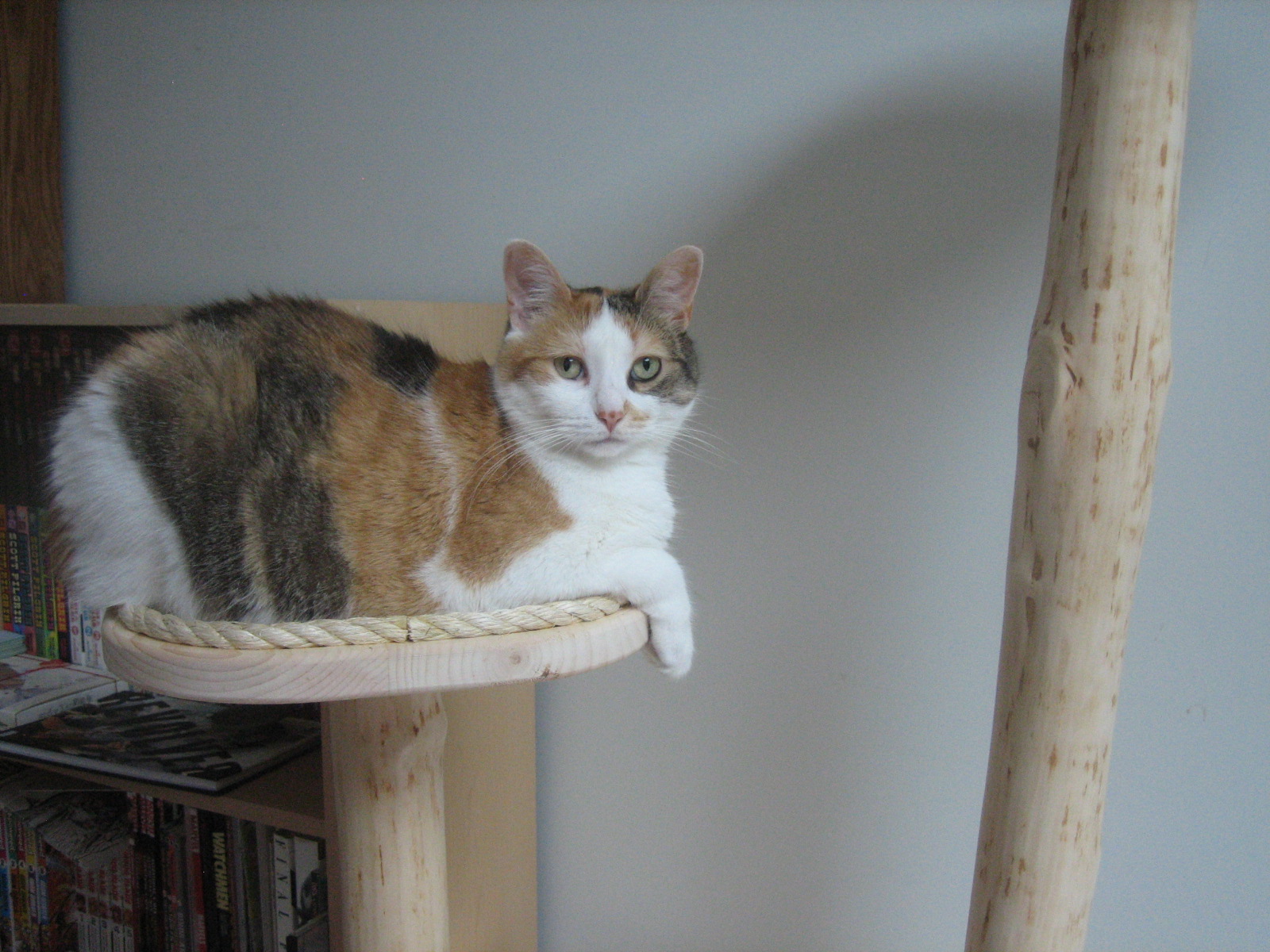
I had to wait a week for Milly to be brave enough to try it out, but as you can see here she's become quite fond of the middle platform. This is Mountain Cat Trees' 58" Three-Level Cat Tree, with platforms at heights of 22", 40", and 58" if you include the base. The posts are birch trunks with the bark removed and the base and platforms are made of textured pine. These trees were harvested after storms when it is easy to find downed trees in the forest, and the wood was treated with a non-toxic clear coat finish.
Putting the tree together was a simple, straight-forward process. The minimalist cardboard and kraft paper packaging was easy to remove and set aside for reuse. I had no trouble following the instructions and was done in about half an hour. I didn't need any tools besides a screwdriver and the enclosed Allan key.
Each platform is bordered with sisal rope. This lets cats really dig their claws in to the edges of the platforms when they reach up and use the edge to stretch. My hope is that the corners of the dining room table become less useful for the same purpose! The sisal scratching post that you can see in the first photo (leaning up against and screwed into the tall post) should also discourage my cats from using the back of the couch to sharpen their claws. Sisal gives them a stronger grip and doesn't feel anything like upholstery!
I'm still waiting for the day that Donut ventures onto the tree and Milly has the guts to scale the 58" high platform. I've been able to entice her up there with catnip, but she never stays too long. If there's one thing I know, it's that you can't force cats to do anything they don't want to, so I'm content to wait for now. I'm just glad that in the mean time, no toxic chemicals are leaching from the tree into the air and onto my cats!
Would you switch to eco-friendly furniture for your pet(s)?
I had to wait a week for Milly to be brave enough to try it out, but as you can see here she's become quite fond of the middle platform. This is Mountain Cat Trees' 58" Three-Level Cat Tree, with platforms at heights of 22", 40", and 58" if you include the base. The posts are birch trunks with the bark removed and the base and platforms are made of textured pine. These trees were harvested after storms when it is easy to find downed trees in the forest, and the wood was treated with a non-toxic clear coat finish.
Putting the tree together was a simple, straight-forward process. The minimalist cardboard and kraft paper packaging was easy to remove and set aside for reuse. I had no trouble following the instructions and was done in about half an hour. I didn't need any tools besides a screwdriver and the enclosed Allan key.
Each platform is bordered with sisal rope. This lets cats really dig their claws in to the edges of the platforms when they reach up and use the edge to stretch. My hope is that the corners of the dining room table become less useful for the same purpose! The sisal scratching post that you can see in the first photo (leaning up against and screwed into the tall post) should also discourage my cats from using the back of the couch to sharpen their claws. Sisal gives them a stronger grip and doesn't feel anything like upholstery!
I'm still waiting for the day that Donut ventures onto the tree and Milly has the guts to scale the 58" high platform. I've been able to entice her up there with catnip, but she never stays too long. If there's one thing I know, it's that you can't force cats to do anything they don't want to, so I'm content to wait for now. I'm just glad that in the mean time, no toxic chemicals are leaching from the tree into the air and onto my cats!
Would you switch to eco-friendly furniture for your pet(s)?
Thursday, June 2, 2011
To zoo or not to zoo, that is the question.
I celebrated my birthday this past weekend. Seeing as I was turning 5, I decided to go to the zoo.
Seeing the big cats at the zoo is a guilty pleasure of mine. Why not just a pleasure, without the guilt? Because most of the cats at the zoo (tigers, lions, cheetahs, leopards, cougars, and jaguars) aren't native to southern Ontario, and part of me believes they don't belong here, not even in the trusted hands of expert zookeepers. There's the standard philosophical issue around whether it's fair to keep animals on display in enclosures, even if they were found injured and wouldn't have survived in the wild, or if they're part of breeding programs to bring back the species from near extinction - but I don't really want to get into that here. My concern stems from the resources required to keep animals in confinement, and whether our reasons for doing so are strong enough to justify the financial and environmental expense.
From feed to medication to staff, large (especially carnivorous) animals require lots of resources. For any of you who own medium to large sized dogs, this concept is likely familiar to you. How much chicken, pork, and beef does a typical zoo use on a daily basis to keep its animals well fed? How many vets and drugs does it take to keep them healthy? How are all of the droppings disposed of?
Most of the animals at the zoo can't handle this climate. Subsequently, they spend the late fall, all winter, and early spring indoors. My mind immediately races through the additional costs associated with that kind of a setup: building construction (materials, energy), heating (energy), lighting (energy), and cleaning (materials, probably toxic ones). I can't help but think about the world's impoverished living in slums, shantytowns, favelas, and tent cities - imagine what all of these resources could do for them!
There are other issues, such as the gas-powered zoomobile, which runs seven to ten hours a day, 364 days a year. Most visitors come by car because the public transit route is extremely long. The picnic tables are underused these days with so many families buying food on site in disposal containers. Don't get me started on the worthlessness of the gift shop!
Enough whining. What's the alternative? After all, zoos serve three important purposes: educating the public, conserving endangered species, and promoting better stewardship of our natural environment. My suggestion is to stick to those goals, but go local. In Montreal, there's a wonderful place called the Ecomuseum Zoo. The animals featured in this zoo are all indigenous to Quebec's St. Lawrence Valley, and the website says...
I'd like to see more of these types of zoos, even if it means no more tigers for me! I'm happy to settle for an Ontario bobcat or lynx, and of course the two little cats indigenous to my living room.
Seeing the big cats at the zoo is a guilty pleasure of mine. Why not just a pleasure, without the guilt? Because most of the cats at the zoo (tigers, lions, cheetahs, leopards, cougars, and jaguars) aren't native to southern Ontario, and part of me believes they don't belong here, not even in the trusted hands of expert zookeepers. There's the standard philosophical issue around whether it's fair to keep animals on display in enclosures, even if they were found injured and wouldn't have survived in the wild, or if they're part of breeding programs to bring back the species from near extinction - but I don't really want to get into that here. My concern stems from the resources required to keep animals in confinement, and whether our reasons for doing so are strong enough to justify the financial and environmental expense.
From feed to medication to staff, large (especially carnivorous) animals require lots of resources. For any of you who own medium to large sized dogs, this concept is likely familiar to you. How much chicken, pork, and beef does a typical zoo use on a daily basis to keep its animals well fed? How many vets and drugs does it take to keep them healthy? How are all of the droppings disposed of?
Most of the animals at the zoo can't handle this climate. Subsequently, they spend the late fall, all winter, and early spring indoors. My mind immediately races through the additional costs associated with that kind of a setup: building construction (materials, energy), heating (energy), lighting (energy), and cleaning (materials, probably toxic ones). I can't help but think about the world's impoverished living in slums, shantytowns, favelas, and tent cities - imagine what all of these resources could do for them!
There are other issues, such as the gas-powered zoomobile, which runs seven to ten hours a day, 364 days a year. Most visitors come by car because the public transit route is extremely long. The picnic tables are underused these days with so many families buying food on site in disposal containers. Don't get me started on the worthlessness of the gift shop!
Enough whining. What's the alternative? After all, zoos serve three important purposes: educating the public, conserving endangered species, and promoting better stewardship of our natural environment. My suggestion is to stick to those goals, but go local. In Montreal, there's a wonderful place called the Ecomuseum Zoo. The animals featured in this zoo are all indigenous to Quebec's St. Lawrence Valley, and the website says...
The animals that reside at the Ecomuseum zoo are all animals that could not survive in their natural environment. Most of our animals are here because they have injuries that would prevent them from surviving in the wild (i.e. They are unable to escape a predator or to eat on their own). All our animals come from accredited rehabilitation centers and zoological institutions. The Ecomuseum zoo is also a refuge for orphaned wildlife and other wild animals born in captivity. In these cases the animals have not acquired the knowledge or learned the behaviours necessary for their survival in the wild, so we offer them protection against predators, food, care and lots of love!
I'd like to see more of these types of zoos, even if it means no more tigers for me! I'm happy to settle for an Ontario bobcat or lynx, and of course the two little cats indigenous to my living room.
Thursday, April 28, 2011
If they're called cat "trees", why are so few of them green?
I've used this blog to endorse lots of things over the past ten months, but I typically only point my thumb in a generally upwards direction when it comes to (1) engaging in behaviours that lower your ecological footprint, (2) attending events that support environmental programs, (3) fighting for policy change at various levels of government, and (4) sharing tips about sustainable living. Today, I'm breaking the rules and advertising eco-friendly cat furniture.
This post was a spur-of-the-moment thing, so instead of images of products that I don't have time to ask permission to use, you get to look at my gorgeous cats. Milly is a six-year-old calico, and Donut is a four year-old tortoiseshell. My partner and I adopted them three years ago from a foster home where they were growing up together, waiting for awesome parents like us to take them home! :)
Donut and Milly may not be human, but they're as close as I'll ever get to having kids, so believe me when I tell you that I often put their needs before my own. It should come as no surprise then that I'm happy to drop lots of money (relatively speaking) on a less wasteful, less toxic cat tree, even if it means I won't be able to buy much needed furniture for myself in the near future. But where are these elusive eco-friendly products? A quick online search yields links to websites that make me feel like I've gotten lost in a warehouse, featuring a few green items scattered here and there among the traditional options that are made of unsustainably harvested wood, covered in toxic carpeting and glues, likely to be tossed long before they're worn out, and just plain ugly.
Enter moderncat, a blog "for cat owners with a modern style" with lots of content in their green design category. That's how I found out about DKcat: design-conscious handcrafted pet accessories made by Danielle Kilmer Warren in the San Francisco Bay Area. Danielle has a background in interior design and sustainability, so she tends to use materials that are natural and durable. Check out this 26" tower with two perches and a scratching post; it's made with formaldehyde-free bamboo, reclaimed wood, and replaceable recycled carpet tiles. All of Danielle's products can be requested in different colours and sizes.
Then I read about Mountain Cat Trees: unique, handcrafted cat perches and scratching posts made with real trees with the bark removed. What a unique and brilliant idea, to make cat trees out of real trees! Massachusetts-based Rebecca Mountain began crafting her first cat trees nearly a decade ago when she realized that the traditional carpeted ones only encouraged her cats to scratch every other carpeted item in her home - so true! Take a look at this 58" three-level tower with scratching post; it looks so much sturdier and more durable than anything I've seen in a big-box pet store.
Next I discovered purr post. This Portland (Oregon) company designs elegant cat furniture that builds sustainability into every detail: from renewable materials like wool and bamboo to 100% post-consumer recycled paperboard to food-grade adhesives that emit zero VOCs and are LEED certified! They offer a 24" post with a wool-covered base and perch that would not look out of place as a bedside table! Bonus: a portion of every sale goes to supporting local and national animal shelters and rescue groups, and you get a sample of organic catnip with your new cat furniture!
Last but certainly not least, I came across another Portland designer: Square Cat Habitat's line of products keep the environment in mind while incorporating modern decor trends. FSC-certified bamboo and 100% post-industrial recycled fibreboard, along with removable/replaceable inserts, help to reduce the ecological footprint of these items. The 3' Acacia tree features two branches and a treetop (almost more napping options than a cat needs, really), but my favourite product is the Buddha wall perch: the perfect place to escape from the world and into the land of dreaming about birds and mice!
Now the hard part: making a decision. Each of these companies offers unique and beautiful cat furniture. Do I support Danielle and her awesome one-woman business? Or should I buy from the company that is closest to me geographically to cut down my shipping-related footprint? Choosing between the two Portland businesses is no easier: one covers its perches with wool (instead of counting sheep when I can't sleep, I picture my cats lounging on the woolly backs of sheep) and the other uses removable/replaceable inserts that speak to the waste reductionist in me.
Help me out: which product would you buy?
| Cat heaven: upcycling a shoebox into a cat bed. |
This post was a spur-of-the-moment thing, so instead of images of products that I don't have time to ask permission to use, you get to look at my gorgeous cats. Milly is a six-year-old calico, and Donut is a four year-old tortoiseshell. My partner and I adopted them three years ago from a foster home where they were growing up together, waiting for awesome parents like us to take them home! :)
Donut and Milly may not be human, but they're as close as I'll ever get to having kids, so believe me when I tell you that I often put their needs before my own. It should come as no surprise then that I'm happy to drop lots of money (relatively speaking) on a less wasteful, less toxic cat tree, even if it means I won't be able to buy much needed furniture for myself in the near future. But where are these elusive eco-friendly products? A quick online search yields links to websites that make me feel like I've gotten lost in a warehouse, featuring a few green items scattered here and there among the traditional options that are made of unsustainably harvested wood, covered in toxic carpeting and glues, likely to be tossed long before they're worn out, and just plain ugly.
Enter moderncat, a blog "for cat owners with a modern style" with lots of content in their green design category. That's how I found out about DKcat: design-conscious handcrafted pet accessories made by Danielle Kilmer Warren in the San Francisco Bay Area. Danielle has a background in interior design and sustainability, so she tends to use materials that are natural and durable. Check out this 26" tower with two perches and a scratching post; it's made with formaldehyde-free bamboo, reclaimed wood, and replaceable recycled carpet tiles. All of Danielle's products can be requested in different colours and sizes.
| Donut sprawled on the footstool... I mean cat bed. |
Then I read about Mountain Cat Trees: unique, handcrafted cat perches and scratching posts made with real trees with the bark removed. What a unique and brilliant idea, to make cat trees out of real trees! Massachusetts-based Rebecca Mountain began crafting her first cat trees nearly a decade ago when she realized that the traditional carpeted ones only encouraged her cats to scratch every other carpeted item in her home - so true! Take a look at this 58" three-level tower with scratching post; it looks so much sturdier and more durable than anything I've seen in a big-box pet store.
Next I discovered purr post. This Portland (Oregon) company designs elegant cat furniture that builds sustainability into every detail: from renewable materials like wool and bamboo to 100% post-consumer recycled paperboard to food-grade adhesives that emit zero VOCs and are LEED certified! They offer a 24" post with a wool-covered base and perch that would not look out of place as a bedside table! Bonus: a portion of every sale goes to supporting local and national animal shelters and rescue groups, and you get a sample of organic catnip with your new cat furniture!
Last but certainly not least, I came across another Portland designer: Square Cat Habitat's line of products keep the environment in mind while incorporating modern decor trends. FSC-certified bamboo and 100% post-industrial recycled fibreboard, along with removable/replaceable inserts, help to reduce the ecological footprint of these items. The 3' Acacia tree features two branches and a treetop (almost more napping options than a cat needs, really), but my favourite product is the Buddha wall perch: the perfect place to escape from the world and into the land of dreaming about birds and mice!
| Milly looking very photogenic on the balcony at our old place. |
Now the hard part: making a decision. Each of these companies offers unique and beautiful cat furniture. Do I support Danielle and her awesome one-woman business? Or should I buy from the company that is closest to me geographically to cut down my shipping-related footprint? Choosing between the two Portland businesses is no easier: one covers its perches with wool (instead of counting sheep when I can't sleep, I picture my cats lounging on the woolly backs of sheep) and the other uses removable/replaceable inserts that speak to the waste reductionist in me.
Help me out: which product would you buy?
Monday, September 27, 2010
Invest In BIXI For a More Sustainable Urban Future
Maybe you're the person who lives outside of the city and likes to come by train to visit every other weekend, then needs a way to get around while here. Or maybe you're the person who doesn't want to invest in a new bike only to have it stolen. Or maybe you're the person heading out to attend an event with friends, but one of you doesn't have their own bike. Or maybe, like me, you'll happily settle for transit (complaining all the while) and walking but believe in making the city more sustainable by reducing vehicle traffic. All are great reasons to register with BIXI Toronto.
This public bike sharing system has already been successfully adopted in Montreal, London, Washington DC, Minneapolis, and Melbourne, and Toronto will follow suit if 1,000 people sign up for a 12-month membership by the end of November. For $95, you will be able to sign out a bike at one of 80 solar-powered docking stations positioned every 300 metres south of Bloor between Spadina and Jarvis, ride it to run an errand, cross town, or just look really cool, then drop it off at any station on the network and enjoy no additional fee as long as your trip took less than 30 minutes.
The bikes themselves are sturdy yet lightweight with aluminum frames, easily adjustable seats, a front rack, lights which are activated when the bike is in motion, and best of all, they're designed and built in Canada. The docking stations, as mentioned above, are powered by the sun, wireless, and require no digging to be installed! In fact, the systems are modular and designed to be so portable that it can take as few as 20 minutes for a team of two to set them up in a new location, which is especially useful for two-day festivals on weekends in areas otherwise unserviced by BIXI.
Once the network has been set up (again, provided a total of at least 1,000 memberships are sold in the next two months), riders can opt for 1-month or 12-month subscriptions purchased online, whereas occasional users can just step up to a docking station and buy a 24-hour pass and make as many 30-minute trips as they'd like over the course of the day. Longer trips cost extra but can be easily avoided by using the bikes only for one-way trips - you don't normally call a taxi to take you to the airport, wait there while you vacation in the south, then bring you home again two weeks later. Hence the name, bicycle + taxi = bixi. It sounds better in French!
Bike sharing systems are important. For everyone's sake, we need to reduce the number of vehicles in use, improve air quality, and allow everyone access to sustainable methods of transportation. BIXI not only brings us closer to these goals but also offers convenience and security. Imagine leaving your own bike at home (or not having to buy one in the first place) yet being able to ride whenever and wherever you need to without having to carry heavy locks, spend time and money on maintenance and accessories, worry about having your own bike stolen, or wonder if the subway will be too crowded to fit your bike when you bring it all the way from home.
The plan is to have 1,000 12-month memberships sold by the end of November (which hasn't happened yet) so that the system can be put into place about six months later, just in time for beautiful cycling weather. Subsequently, use of the program is expected to increase as the bikes and docking stations will be everywhere and pretty much advertise themselves. This will allow the network to be expanded and the number of bikes to increase. So even if you don't live in the proposed service area, invest in the system today to make use of it tomorrow. This is just like raising capital to start up a business, but without having to worry about whether it will take off: the statistics from Montreal prove just how successful the program can be!
I hope you will give this some thought, talk about it with your family, friends, and colleagues, and of course, register by November 30th, 2010! (Don't worry, you will receive a full refund if the target isn't met.)
This public bike sharing system has already been successfully adopted in Montreal, London, Washington DC, Minneapolis, and Melbourne, and Toronto will follow suit if 1,000 people sign up for a 12-month membership by the end of November. For $95, you will be able to sign out a bike at one of 80 solar-powered docking stations positioned every 300 metres south of Bloor between Spadina and Jarvis, ride it to run an errand, cross town, or just look really cool, then drop it off at any station on the network and enjoy no additional fee as long as your trip took less than 30 minutes.
The bikes themselves are sturdy yet lightweight with aluminum frames, easily adjustable seats, a front rack, lights which are activated when the bike is in motion, and best of all, they're designed and built in Canada. The docking stations, as mentioned above, are powered by the sun, wireless, and require no digging to be installed! In fact, the systems are modular and designed to be so portable that it can take as few as 20 minutes for a team of two to set them up in a new location, which is especially useful for two-day festivals on weekends in areas otherwise unserviced by BIXI.
Once the network has been set up (again, provided a total of at least 1,000 memberships are sold in the next two months), riders can opt for 1-month or 12-month subscriptions purchased online, whereas occasional users can just step up to a docking station and buy a 24-hour pass and make as many 30-minute trips as they'd like over the course of the day. Longer trips cost extra but can be easily avoided by using the bikes only for one-way trips - you don't normally call a taxi to take you to the airport, wait there while you vacation in the south, then bring you home again two weeks later. Hence the name, bicycle + taxi = bixi. It sounds better in French!
Bike sharing systems are important. For everyone's sake, we need to reduce the number of vehicles in use, improve air quality, and allow everyone access to sustainable methods of transportation. BIXI not only brings us closer to these goals but also offers convenience and security. Imagine leaving your own bike at home (or not having to buy one in the first place) yet being able to ride whenever and wherever you need to without having to carry heavy locks, spend time and money on maintenance and accessories, worry about having your own bike stolen, or wonder if the subway will be too crowded to fit your bike when you bring it all the way from home.
The plan is to have 1,000 12-month memberships sold by the end of November (which hasn't happened yet) so that the system can be put into place about six months later, just in time for beautiful cycling weather. Subsequently, use of the program is expected to increase as the bikes and docking stations will be everywhere and pretty much advertise themselves. This will allow the network to be expanded and the number of bikes to increase. So even if you don't live in the proposed service area, invest in the system today to make use of it tomorrow. This is just like raising capital to start up a business, but without having to worry about whether it will take off: the statistics from Montreal prove just how successful the program can be!
- in its first year (2009), 1.14 million BIXI trips were made, 10,775 riders purchased 1-yr subscriptions, and over 100,000 24-hour passes were used
- 86% of 2009 subscribers intended to renew for 2010
- 91% of Montrealers are aware of the BIXI program
- the system expanded from 3,000 bikes at 300 stations when it launched in May 2009 to 5,000 bikes at 400 stations within six months!
- there were 20,000 subscribers by May 2010, just one year after the program was started!
I hope you will give this some thought, talk about it with your family, friends, and colleagues, and of course, register by November 30th, 2010! (Don't worry, you will receive a full refund if the target isn't met.)
Tuesday, July 6, 2010
Eat More (Healthy, Sustainable) Fish!
It's refreshing to witness the public's growing interest in eating less meat due to health, ecological, and global hunger issues. I hope it's old news to you that turning cows into beef on Factory Farms involves (1) mixing hormones and antibiotics directly into the feed (which are passed on to the consumer along with loads of fat and cholesterol); (2) using massive amounts of water for indoor systems and land for pasture; and (3) driving deforestation in the Amazon to grow corn and soy beans to feed the cows instead of feeding people directly. Stay tuned for one to ten thousand more posts on this issue later...
Fortunately, people seem to be turning to fish (and the occasional vegetarian meal) to fill the gap left behind by a less bovine-heavy diet. Generally speaking, fish is a good source of protein but lower in fat than meat. And don't let the term "fatty fish" fool you: omega-3 fatty acids help prevent heart disease and stroke. Eating fish as opposed to beef means you're ingesting a healthier type and amount of cholesterol. The distressing downside to eating significant amounts of certain types of fish is the mercury that comes along for the ride - and we can blame ourselves for that.
The bigger issue with the Western world eating more fish is that we're driving lots of varieties to extinction. Take bluefin tuna, for example. Not its kid brother, albacore (the type we eat from cans), but rather the 200 kg giants that sell for over $100,000 in Tokyo fish markets. It's so valuable that it has become critically endangered from overfishing - but not internationally protected because Japan is addicted to bluefin sashimi (understandably; it's so darn tasty!). The fishing industry continues to plunder the seas with no regard for sustaining the existing stocks, expecting to move on to Fish Types E and F once they have successfully driven Fish Types A, B, C, and D to extinction. To make matters worse, there is growing concern that the BP oil spill is decimating what remains of the stocks. That's two strikes against humanity.
Unfortunately, fish farms aren't the answer. They share a lot of the same criticisms I outlined above. Untreated fecal waste pollutes the surrounding aquatic ecosystem; diseases and parasites spread like epidemics within the overcrowded cages (often resulting in the complete slaughter of the stock) and can spread to wild fish populations; antibiotics in the feed promote the evolution of resistant strains of bacteria; and lastly, brace yourself for the irony here, other wild fish stocks are being depleted in order to feed farmed fish. This is especially true for large, (obviously) carnivorous types of farmed fish, most notably salmon.
Now that I've painted this glorious picture of current fishing practices, you might be wondering what your options are. Luckily there are still many ways to enjoy fish in your diet without having to worry about excessive mercury, antibiotics, or guilt over driving wild stocks to extinction. Check out the following links:
Fortunately, people seem to be turning to fish (and the occasional vegetarian meal) to fill the gap left behind by a less bovine-heavy diet. Generally speaking, fish is a good source of protein but lower in fat than meat. And don't let the term "fatty fish" fool you: omega-3 fatty acids help prevent heart disease and stroke. Eating fish as opposed to beef means you're ingesting a healthier type and amount of cholesterol. The distressing downside to eating significant amounts of certain types of fish is the mercury that comes along for the ride - and we can blame ourselves for that.
The bigger issue with the Western world eating more fish is that we're driving lots of varieties to extinction. Take bluefin tuna, for example. Not its kid brother, albacore (the type we eat from cans), but rather the 200 kg giants that sell for over $100,000 in Tokyo fish markets. It's so valuable that it has become critically endangered from overfishing - but not internationally protected because Japan is addicted to bluefin sashimi (understandably; it's so darn tasty!). The fishing industry continues to plunder the seas with no regard for sustaining the existing stocks, expecting to move on to Fish Types E and F once they have successfully driven Fish Types A, B, C, and D to extinction. To make matters worse, there is growing concern that the BP oil spill is decimating what remains of the stocks. That's two strikes against humanity.
Unfortunately, fish farms aren't the answer. They share a lot of the same criticisms I outlined above. Untreated fecal waste pollutes the surrounding aquatic ecosystem; diseases and parasites spread like epidemics within the overcrowded cages (often resulting in the complete slaughter of the stock) and can spread to wild fish populations; antibiotics in the feed promote the evolution of resistant strains of bacteria; and lastly, brace yourself for the irony here, other wild fish stocks are being depleted in order to feed farmed fish. This is especially true for large, (obviously) carnivorous types of farmed fish, most notably salmon.
Now that I've painted this glorious picture of current fishing practices, you might be wondering what your options are. Luckily there are still many ways to enjoy fish in your diet without having to worry about excessive mercury, antibiotics, or guilt over driving wild stocks to extinction. Check out the following links:
- Sea Choice Seafood Guide (Canadian)
- Monterey Bay Aquarium Seafood Watch (American)
- WWF Sustainable Seafood Consumer Guide (various countries)
Subscribe to:
Posts (Atom)