It's Friday, and in my books, that means it's time to feel good.
Let's set aside the doom-and-gloom stories for a moment and focus
on some good news!
--------------------
Today's FFGN is less about news and more about feeling good. Check out this cute Star Wars-themed parody of the war between conventional and organic food:
It's so cheesy but so funny at the same time! The facts about unsustainable practices in modern industrial farming must get out to more people; why not speak in a language that a huge chunk of the population understands? Obi-Wan Cannoli is right when he says that people don't even want to know where their food comes from, they just want low prices. Who knows, maybe someday it will be possible for a potato "father" to have a cucumber "son" thanks to genetic engineering.
I hope you enjoyed the video, and have a great weekend!
Showing posts with label sustainable farming. Show all posts
Showing posts with label sustainable farming. Show all posts
Friday, November 18, 2011

Wednesday, June 29, 2011
Meet City Seed Farms
If you live in Toronto and haven't heard of City Seed Farms, you're missing out! City Seed Farms is a brand new backyard farming business that grows veggies in west end gardens and sells them at Sorauren Farmers' Market. I asked founder Erica Lemieux to tell us more about her new business.

How did you come up with this concept?
It hit me like a lightning bolt while visiting an urban farm in Kelowna, BC. I had been working with another backyard farming group in Toronto, the Young Urban Farmers CSA, and so urban farming already consumed my mind. Seeing the operation in Kelowna work so well and enjoy numerous successes in its first year was fodder in the trough. Fuel on the fire. It just added electricity to an already raging thunderstorm of excitement going on in my own head. I was really recognizing an opportunity that I needed to seize. Potential to harness. Bicycle-powered backyard farming in High Park. It all made so much sense.
I recall saying to the head farmer in Kelowna, "I think I should do this in Toronto". He replied, "Heck yeah! Get on the next bus home and start asking your neighbours if they'd be interested in sharing their yards". So I did. I went door to door with a City Seed Farms brochure, saying, "Hi, I'm your neighbour. Are you interested in seeing part of your backyard turned into a productive vegetable garden?" I just wanted to assess the interest of the homeowners in my neighbourhood. Within a couple of days I had seven responses. To date, I have ten yards under cultivation.
What else will you be doing with your crops besides selling them at the Sorauren Farmers' Market? Does any of it go to the homeowners, and will you be selling your produce to any restaurants?
We give a weekly share to each landowner and bring the rest to four restaurants in the area.

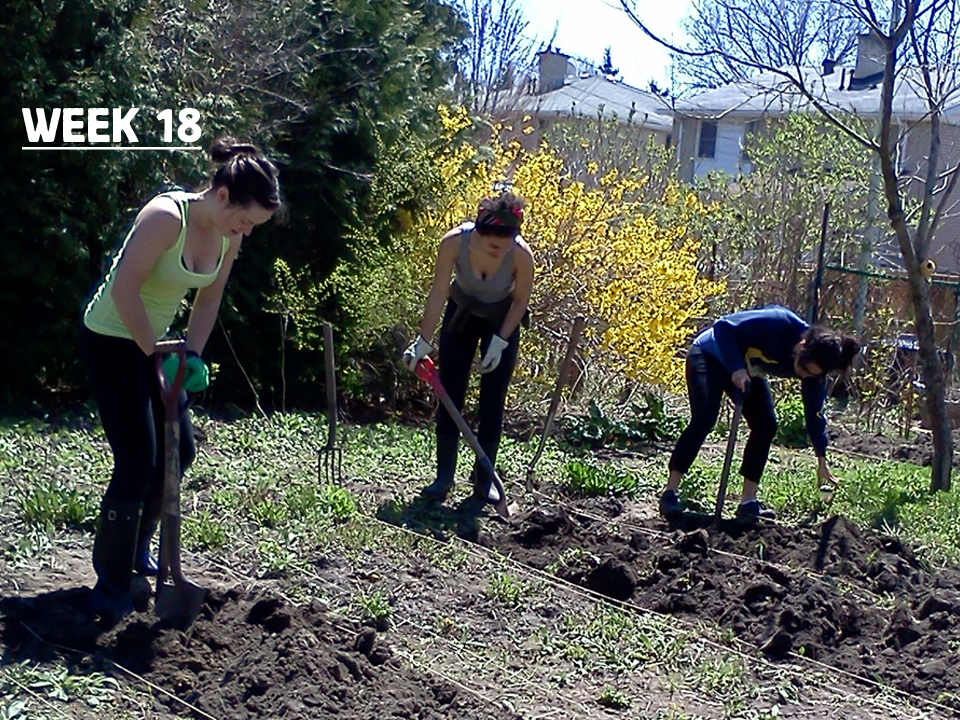
From my experience volunteering with Young Urban Farmers CSA, I know that turning a back yard lawn into veggie beds is hard work. Who helped you do all of that double-digging?
My sister and my cousin, as well as about ten other friends and volunteers. I provided the granola bars and they provided the strong backs and stamina.
Your backyard growing method is a form of SPIN (Small Plot INtensive) farming. Can you explain to the readers what that's all about and how you make it work?
SPIN farming is a method of farming that maximizes yield and profit in small plots of land. It is meant for plots in the 1/8 - 1/2 acre range. It uses farming methods like relay cropping and standardized bed sizes to make the operation efficient and consistent. For instance, I will plant one backyard with entirely low-intensive crops like squash and beans so that I can allot a certain amount of attention to that yard and not leave any crops to become neglected. All the high-intensity crops like lettuces, arugula, spinach, radishes, etc., are also clustered together. This allows me to focus my time and energy at the sites that need it.
If the SPIN farming method comes through for you, how long do you think it might take until this business transitions from a cost-recovery model to making a healthy profit?
End of next year. Once I pay off my start-up costs like my rototiller and double-door refrigeration unit, I feel that City Seed can profit.
A very important question: what are you growing this year?
Mmmm. We have so much bounty in the gardens right now. Carrots, beets, radishes, leafy greens of all sorts, herbs, broccoli, cauliflower, onions, pearl onions, bunching onions, peas, beans, squash, pumpkins, tomatoes, peppers. My favourite plant is the beautiful and tasty Bordeaux Spinach. It has a fiery red stem and tastes more spinachy than any spinach I've ever had.

What do you think City Seed Farms will look like in five years? In ten?
I hope that City Seed Farms flourishes the way I imagine it. I want this business to continue on its path toward becoming a trusted name in west Toronto, and a legitimate and substantial contribution to the food supply in my community. I want to see our fleet of four bikes grow to forty. Our yards from ten to one hundred. Ideally, every backyard in Toronto will be a mini-farm by the ten year mark.
Do it. The resources and support are there. The opportunity and need that exists around urban farming is real and pertinent. Hope on board! There is no better time than now.
------------------------------
If you would like more information, check out the City Seed Farms website! You can also e-mail Erica at lemieux.erica(at)gmail.com.
All photos used by permission from Erica Lemieux/City Seed Farms.
How did you come up with this concept?
It hit me like a lightning bolt while visiting an urban farm in Kelowna, BC. I had been working with another backyard farming group in Toronto, the Young Urban Farmers CSA, and so urban farming already consumed my mind. Seeing the operation in Kelowna work so well and enjoy numerous successes in its first year was fodder in the trough. Fuel on the fire. It just added electricity to an already raging thunderstorm of excitement going on in my own head. I was really recognizing an opportunity that I needed to seize. Potential to harness. Bicycle-powered backyard farming in High Park. It all made so much sense.
I recall saying to the head farmer in Kelowna, "I think I should do this in Toronto". He replied, "Heck yeah! Get on the next bus home and start asking your neighbours if they'd be interested in sharing their yards". So I did. I went door to door with a City Seed Farms brochure, saying, "Hi, I'm your neighbour. Are you interested in seeing part of your backyard turned into a productive vegetable garden?" I just wanted to assess the interest of the homeowners in my neighbourhood. Within a couple of days I had seven responses. To date, I have ten yards under cultivation.
What else will you be doing with your crops besides selling them at the Sorauren Farmers' Market? Does any of it go to the homeowners, and will you be selling your produce to any restaurants?
We give a weekly share to each landowner and bring the rest to four restaurants in the area.

From my experience volunteering with Young Urban Farmers CSA, I know that turning a back yard lawn into veggie beds is hard work. Who helped you do all of that double-digging?
My sister and my cousin, as well as about ten other friends and volunteers. I provided the granola bars and they provided the strong backs and stamina.
Your backyard growing method is a form of SPIN (Small Plot INtensive) farming. Can you explain to the readers what that's all about and how you make it work?
SPIN farming is a method of farming that maximizes yield and profit in small plots of land. It is meant for plots in the 1/8 - 1/2 acre range. It uses farming methods like relay cropping and standardized bed sizes to make the operation efficient and consistent. For instance, I will plant one backyard with entirely low-intensive crops like squash and beans so that I can allot a certain amount of attention to that yard and not leave any crops to become neglected. All the high-intensity crops like lettuces, arugula, spinach, radishes, etc., are also clustered together. This allows me to focus my time and energy at the sites that need it.
If the SPIN farming method comes through for you, how long do you think it might take until this business transitions from a cost-recovery model to making a healthy profit?
End of next year. Once I pay off my start-up costs like my rototiller and double-door refrigeration unit, I feel that City Seed can profit.
A very important question: what are you growing this year?
Mmmm. We have so much bounty in the gardens right now. Carrots, beets, radishes, leafy greens of all sorts, herbs, broccoli, cauliflower, onions, pearl onions, bunching onions, peas, beans, squash, pumpkins, tomatoes, peppers. My favourite plant is the beautiful and tasty Bordeaux Spinach. It has a fiery red stem and tastes more spinachy than any spinach I've ever had.

What do you think City Seed Farms will look like in five years? In ten?
I hope that City Seed Farms flourishes the way I imagine it. I want this business to continue on its path toward becoming a trusted name in west Toronto, and a legitimate and substantial contribution to the food supply in my community. I want to see our fleet of four bikes grow to forty. Our yards from ten to one hundred. Ideally, every backyard in Toronto will be a mini-farm by the ten year mark.
What advice do you have for young farmers who might like to follow in your footsteps?
Do it. The resources and support are there. The opportunity and need that exists around urban farming is real and pertinent. Hope on board! There is no better time than now.
------------------------------
If you would like more information, check out the City Seed Farms website! You can also e-mail Erica at lemieux.erica(at)gmail.com.
All photos used by permission from Erica Lemieux/City Seed Farms.
Wednesday, June 8, 2011
Get Your Share of Locally and Sustainably Grown Veggies
Take some seeds, one part rain, two parts sun, and a generous amount of heat, and all that's missing is you: it's time to purchase your share in Young Urban Farmers Community Shared Agriculture program!

It only costs the equivalent of six lattes a week to get your hands on a bounty of the freshest, most locally grown veggies in Toronto. This is Young Urban Farmers CSA's second year growing food in backyards in the Wychwood, Lawrence Park, and Riverdale neighbourhoods, and it's going to be a great season. I've already told you how thrilling it was to receive and cook with veggies grown minutes from my home (especially considering I don't have a garden of my own), and I've alluded to my rewarding volunteer involvement with YUF CSA; now it's time to fit you into this picture. I am shamelessly advertising this great opportunity because I've benefited so much from it and really want to see the organization thrive.
What do you get? Only the tastiest GMO-free, organically grown heirloom varieties of leaf lettuce, spinach, swiss chard, kale, broccoli, radishes, beets, carrots, leeks, garlic, spring onions, shallots, tomatoes, bell peppers, hot peppers, eggplant, beans, peas, zucchini, summer squash, cucumbers, and herbs. Southern Ontario simply overflows with food in the summer months; why would you want to buy imported veggies trucked in from far away to the supermarket? Even a farmer's market can't beat this freshness - you take home your share mere hours after it was harvested, often in the very same garden it was grown in.
Support your health, the environment, and the local economy by investing in YUF CSA today. If you don't live in Toronto, please pass this on to those you know that do, and click here for a list of CSAs in Ontario.
Do you own a share in a CSA? If not, what's holding you back?

It only costs the equivalent of six lattes a week to get your hands on a bounty of the freshest, most locally grown veggies in Toronto. This is Young Urban Farmers CSA's second year growing food in backyards in the Wychwood, Lawrence Park, and Riverdale neighbourhoods, and it's going to be a great season. I've already told you how thrilling it was to receive and cook with veggies grown minutes from my home (especially considering I don't have a garden of my own), and I've alluded to my rewarding volunteer involvement with YUF CSA; now it's time to fit you into this picture. I am shamelessly advertising this great opportunity because I've benefited so much from it and really want to see the organization thrive.
What do you get? Only the tastiest GMO-free, organically grown heirloom varieties of leaf lettuce, spinach, swiss chard, kale, broccoli, radishes, beets, carrots, leeks, garlic, spring onions, shallots, tomatoes, bell peppers, hot peppers, eggplant, beans, peas, zucchini, summer squash, cucumbers, and herbs. Southern Ontario simply overflows with food in the summer months; why would you want to buy imported veggies trucked in from far away to the supermarket? Even a farmer's market can't beat this freshness - you take home your share mere hours after it was harvested, often in the very same garden it was grown in.
Support your health, the environment, and the local economy by investing in YUF CSA today. If you don't live in Toronto, please pass this on to those you know that do, and click here for a list of CSAs in Ontario.
Do you own a share in a CSA? If not, what's holding you back?
Tuesday, January 11, 2011
Speaking of the Flu...
After being bedridden with the flu over the weekend and taking it easy for an additional day (I engage in the practice of not rushing back to the daily grind prematurely because that tends to encourage a follow-up cold/flu), I am now feeling like my physical self has recovered most of its strength. My mental abilities, though, seem to be readjusting more slowly, hesitant to go back into productive mode.

That being said, I should be able to write a quick post about swine flu. Not H1N1, necessarily; I'm referring to the flu viruses that originate in pigs. It seems an author at Scientific American is worried that there isn't enough monitoring of pig health on American farms, mainly because the pork industry isn't interested in playing show-and-tell with its data. I don't know about you, but I only remember hiding things as a child when I was worried about getting in trouble. Suspicious, anyone?
It turns out the Centers for Disease Control and Prevention are informed when a human catches the flu off a pig but can't always investigate because the contagious animal is often... already taken care of by the time officials arrive on site. And although the US Department of Agriculture has come up with a fancy surveillance system, it hasn't been set up because the pork industry, surprise surprise, isn't excited about the government meddling in its affairs. I can just hear them now, "this is a free country; all we're asking for the is the right to treat these intelligent animals really poorly, sell their meat for the greatest profit possible, and unleash the next great flu pandemic on the world, without Uncle Sam looking over our shoulders".

Let's be clear: it's unlikely that pigs living on farms using friendly (read: sustainable and ethical) livestock management strategies are the ones getting sick all the time. Imagine instead the overcrowded pens in a factory farm environment where pigs are given a daily regimen of antibiotics to mitigate the spread of disease - except antibiotics don't prevent or cure the flu! Just as you and I are exposed to cold and flu viruses when working in a busy office, taking the subway during rush hour, or visiting an Apple store, and just as that exposure leads to illness when we are under stress, the pigs living in factory farms are pretty much destined to pass around viral diseases during the time they are housed there. Then it's just a matter of time before the workers who come into contact with the animals pick up the flu from them, provided the virus has mutated into a form that can affect humans. A bleak future, indeed.
So what do we do? 1. Vote with our dollars and boycott meat from factory farms, choosing animals products from sustainable farms instead. 2. Lobby our elected officials to introduce stricter regulations on these industries. 3. Support local farmers so that less meat is imported from foreign countries where the oversight is even poorer.
If you'd like to read the blog post that clued me in on this issue, click here.
Photo credits: H1N1 virus; pig pens.

That being said, I should be able to write a quick post about swine flu. Not H1N1, necessarily; I'm referring to the flu viruses that originate in pigs. It seems an author at Scientific American is worried that there isn't enough monitoring of pig health on American farms, mainly because the pork industry isn't interested in playing show-and-tell with its data. I don't know about you, but I only remember hiding things as a child when I was worried about getting in trouble. Suspicious, anyone?
It turns out the Centers for Disease Control and Prevention are informed when a human catches the flu off a pig but can't always investigate because the contagious animal is often... already taken care of by the time officials arrive on site. And although the US Department of Agriculture has come up with a fancy surveillance system, it hasn't been set up because the pork industry, surprise surprise, isn't excited about the government meddling in its affairs. I can just hear them now, "this is a free country; all we're asking for the is the right to treat these intelligent animals really poorly, sell their meat for the greatest profit possible, and unleash the next great flu pandemic on the world, without Uncle Sam looking over our shoulders".

Let's be clear: it's unlikely that pigs living on farms using friendly (read: sustainable and ethical) livestock management strategies are the ones getting sick all the time. Imagine instead the overcrowded pens in a factory farm environment where pigs are given a daily regimen of antibiotics to mitigate the spread of disease - except antibiotics don't prevent or cure the flu! Just as you and I are exposed to cold and flu viruses when working in a busy office, taking the subway during rush hour, or visiting an Apple store, and just as that exposure leads to illness when we are under stress, the pigs living in factory farms are pretty much destined to pass around viral diseases during the time they are housed there. Then it's just a matter of time before the workers who come into contact with the animals pick up the flu from them, provided the virus has mutated into a form that can affect humans. A bleak future, indeed.
So what do we do? 1. Vote with our dollars and boycott meat from factory farms, choosing animals products from sustainable farms instead. 2. Lobby our elected officials to introduce stricter regulations on these industries. 3. Support local farmers so that less meat is imported from foreign countries where the oversight is even poorer.
If you'd like to read the blog post that clued me in on this issue, click here.
Photo credits: H1N1 virus; pig pens.


Wednesday, January 5, 2011
Day 4 - Food
This week I'm experimenting with No Impact Week, exploring some of my past successes at decreasing my carbon footprint and generating even better ideas for the future. My goal is to challenge myself to redo the week later this year when it will have the greatest impact on my day-to-day life. Click here for a review of Day 1 - Consumption, Day 2 - Trash, and Day 3 - Transportation.
--------------------
Day 4 - Food
This could be a very long post. When it comes to environmental issues, problems with the way we grow, process, market, consume, and waste food pretty much top the list for me. So instead of writing until 2012, I'll keep things brief by giving you a bullet-point list of the things I do to lower my food-related carbon footprint. Get comfy, this will still be long.


I couldn't write this post without talking about the importance of developing local food systems. In fact, besides trying to cut out more meat, dairy, and non-local, unseasonal produce from my diet, working to change our food system can have a big impact on my carbon footprint, and yours, too. To that effect, check out these eleven great ideas for contributing to the good food movement, brought to you by Food Forward. You don't have to make eleven changes; just choose the ones that are practical and achievable for you, and pass on the list to your family, friends, and colleagues. We're all in this together.
--------------------
When it comes to our impact on the planet, despite the bad news and warnings that we've passed the point where we can fix this mess we're in, I remain inspired, heartened, motivated, grateful for, and deeply happy that we live in an age where it is possible to make the kinds of choices I've been talking about all week. Thank you, humanity.
Photo credits: Tsukiji tuna market; coffee/tea/sugar containers.
--------------------
Day 4 - Food
This could be a very long post. When it comes to environmental issues, problems with the way we grow, process, market, consume, and waste food pretty much top the list for me. So instead of writing until 2012, I'll keep things brief by giving you a bullet-point list of the things I do to lower my food-related carbon footprint. Get comfy, this will still be long.
 |
| A selection of produce from my CSA share, late July 2010. |
- I'm a big fan of eating locally and seasonally, and I held true to my values over the summer by participating in Young Urban Farmers CSA. In the fall, I went to my local farmers' market as often as I could, but since it's open on Saturdays and the past two fell on holidays... let's say my fridge doesn't have a lot of Ontario-grown produce in it right now.
- I'm happy to state that I've made big strides in the direction of vegetarianism! My general rules are to avoid meat altogether when I'm dining out, unless the restaurant uses a local, hormone- and antibiotic-free, non-factory farm source for their meat. I try to keep to the same criteria when I find myself in front of a butcher counter, and when I can afford it, I cross town to visit butchers who sell organic meat from farmers they actually know. Raising cows is one of the most resource-intensive and polluting agricultural activities, so I have almost completely cut beef out of my diet - and between you and me (and the entire internet, haha) I find Betsy kinda boring, with the exception of using slices of flank steak for a stir-fry. Will I eventually become a vegetarian? It's quite likely.
- I carry a pocket guide that indicates which fish have been caught/raised in environmentally sustainable ways and have a low mercury content (three cheers for Toronto Public Health) to make smart decisions. Goodbye salmon, shrimp, red snapper, and tuna. Those are the losses I feel most acutely. Sea urchin, on the other hand - my brother can attest to this - I am not sad to see in the "bad choice" column.

- The bad news? Off the top of my head, these are some of the foods from outside of Ontario that I currently can't bring myself to give up: avocados, bananas, citrus (lemons, oranges, and clementines), mangoes, olives and olive oil, pineapples, rice, salt, and wheat (bread). The good news? I don't have to feel too guilty about my consumption of chocolate if I switch from a fancy Swiss brand to Chocosol, purveyors of artisanal chocolate made from cacao beans that have been fairly traded for in a socially just way, plus other ingredients that are grown locally. And the real kicker is that the final product is delivered to your door by bike! Be still my beating heart...
- The big dilemma: what to do about coffee and tea. I mostly quit coffee in 2006 for health reasons (consuming either too much or too little caffeine in coffee format was causing migraines as a withdrawal/overdose symptom) and I continue to avoid it most days of the week - not an easy feat considering I'm tempted every day, living in a neighbourhood with some of the best espresso outside of Italy. But what about tea, that warming, soothing, nourishing beverage that I can't go without for more than a few hours at a time? Does it help that half of what I own is organic? Does it matter that I sometimes drink a tisane made entirely from Ontario-grown herbs (thank you for cluing me in on this blend, Karen at Stratford Tea Leaves)? Am I making a noticeable difference by drinking loose leaf teas rather than using tea bags, which require extra resources and much more processing? What about the fact that unlike coffee, I don't add any milk or sugar to tea? Or, consider this: isn't tea responsible for lower transportation-related greenhouse gas emissions than coffee (on a cup for cup basis, due to how much less tea you need, and how much less it weighs than coffee)? I'll need some time to better research this topic!

- Let's not forget alcoholic beverages. I buy local wines from Niagara and über-local beer from downtown (Steam Whistle, Mill St., and Amsterdam). Enough said.
- For the most part, I don't buy a lot of processed foods; I ate my last McMeal over ten years ago and will never go back; I cook at home rather than order in; I brown-bag my lunch instead of heading to the food court; I occasionally bake my own bread and pizza dough (like today!); and when I dine out, I prefer restaurants that respect the slow food approach and I'm always on lookout for restaurants that serve Local Food Plus certified food.
I couldn't write this post without talking about the importance of developing local food systems. In fact, besides trying to cut out more meat, dairy, and non-local, unseasonal produce from my diet, working to change our food system can have a big impact on my carbon footprint, and yours, too. To that effect, check out these eleven great ideas for contributing to the good food movement, brought to you by Food Forward. You don't have to make eleven changes; just choose the ones that are practical and achievable for you, and pass on the list to your family, friends, and colleagues. We're all in this together.
--------------------
When it comes to our impact on the planet, despite the bad news and warnings that we've passed the point where we can fix this mess we're in, I remain inspired, heartened, motivated, grateful for, and deeply happy that we live in an age where it is possible to make the kinds of choices I've been talking about all week. Thank you, humanity.
Photo credits: Tsukiji tuna market; coffee/tea/sugar containers.
Monday, August 9, 2010
Conscious Food Festival
I'll be out of town, but for those of you who can make it, the first annual Conscious Food Festival is taking place this weekend at Fort York in Toronto. It's a big ole' party featuring local, sustainable food. Yum!
Tickets are $18 in advance / $23 at the gate, and include five food/drink sample vouchers.
Check out the details here.
Tickets are $18 in advance / $23 at the gate, and include five food/drink sample vouchers.
Check out the details here.
Saturday, August 7, 2010
Local Food Plus
I've been looking forward to writing this post since Wednesday evening. In anticipation, I began thinking about the kinds of pictures I could take to accompany the text, but came up empty because my local grocery store has not partnered with Local Food Plus (LFP) to offer certified local, sustainable food. Sure, there are lots of Ontario-grown peaches and corn in the fruit and veggie section, but there's no way to know how many pesticides I'm ingesting when consuming this produce. LFP is trying to change that.

Ah, a picture! This is the button I received for taking the Buy To Vote pledge. In case it's too blurry to read, the inside of the circle reads, "certified, local, sustainable". More on that later.
On my way home on Wednesday evening, I felt excited and inspired - hence my desire to write this post. I had just attended a seminar, as part of a volunteer training session, led by none other than the President and Founder of LFP, Lori Stahlbrand. In 2005, this food superhero came up with the idea of creating a certification system to benefit not only the local farmers who use sustainable methods in growing food but also people like you and me who want to know where our food is coming from and to which extent it is either damaging or preserving the natural environment... and our bodies!
You may be asking yourself, "What makes the existing food system so environmentally unsustainable, anyway?" Lots of things! Traditional farming methods have negative effects on:
Okay, this post is getting long. Still with me? Still remember my button, pictured above? I wear it proudly on my purse to help spread the word about the importance of supporting a sustainable food system. It was given to me when, at the Green Living Show earlier this year, I signed a pledge to "vote with my dollars" and shift $10 of my weekly food expenses to certified local, sustainable food. I'm pretty sure I've done much more than that since joining the Young Urban Farmers CSA (see my previous post about it)! Apparently, if 5,000 of us take the pledge, we can cut enough greenhouse gas emissions to equal taking 500 cars off the road and pump enough new money into our local economy to create 50 new jobs, each year, and that's just in Ontario!
So if you support these values, take the pledge already!
And if you're looking for places to shop and eat local and sustainable food, consult this guide.
Happy harvest.

Ah, a picture! This is the button I received for taking the Buy To Vote pledge. In case it's too blurry to read, the inside of the circle reads, "certified, local, sustainable". More on that later.
On my way home on Wednesday evening, I felt excited and inspired - hence my desire to write this post. I had just attended a seminar, as part of a volunteer training session, led by none other than the President and Founder of LFP, Lori Stahlbrand. In 2005, this food superhero came up with the idea of creating a certification system to benefit not only the local farmers who use sustainable methods in growing food but also people like you and me who want to know where our food is coming from and to which extent it is either damaging or preserving the natural environment... and our bodies!
You may be asking yourself, "What makes the existing food system so environmentally unsustainable, anyway?" Lots of things! Traditional farming methods have negative effects on:
- water quality: toxic chemicals from pesticides and fertilizer end up in the groundwater
- soil quality: the land is farmed so intensely that the nutrients are depleted and not replenished (hence the ever-increasing need for fertilizer)
- biodiversity: endless fields growing the same crop and no remaining wild areas result in a loss of habitat for many species
- air quality: I don't even want to hazard a guess at how many greenhouse gas emissions spew out of a truck while it carries strawberries from California to my neighbourhood
- sustainable production systems: reduce/eliminate synthetic pesticides and fertilizers as well as hormones, antibiotics, and GMOs, and conserve soil and water
- labour: provide safe and fair working conditions for employees
- livestock: provide healthy and humane care for the animals being raised on the farm
- biodiversity: protect and enhance wildlife habitat
- energy conservation: reduce on-farm energy consumption and greenhouse gases
Okay, this post is getting long. Still with me? Still remember my button, pictured above? I wear it proudly on my purse to help spread the word about the importance of supporting a sustainable food system. It was given to me when, at the Green Living Show earlier this year, I signed a pledge to "vote with my dollars" and shift $10 of my weekly food expenses to certified local, sustainable food. I'm pretty sure I've done much more than that since joining the Young Urban Farmers CSA (see my previous post about it)! Apparently, if 5,000 of us take the pledge, we can cut enough greenhouse gas emissions to equal taking 500 cars off the road and pump enough new money into our local economy to create 50 new jobs, each year, and that's just in Ontario!
So if you support these values, take the pledge already!
And if you're looking for places to shop and eat local and sustainable food, consult this guide.
Happy harvest.
Saturday, July 31, 2010
CSAs: Part of Healthy Diet
What happens when you mix heirloom plants, fertile urban gardens, high heat on sunny days (interspersed with short-lived but heavy rain showers), and lots of hard work from dedicated farmers?

A gorgeous crop of fruit and vegetables grown no farther than a dozen or so km from where I live. All mine!
That's because I bought a share with the Young Urban Farmers (YUF) CSA (community shared agriculture) to be able to enjoy more tasty food than I can consume within a week for the rest of the growing season. Featured in this week's share were, in alphabetical order:
When I decided to join a CSA this year, I had some difficulty deciding which one to put my money behind. Luckily, I came across YUF and immediately fell in love with them: they grow their produce in city residents' backyards, not a suburban farm! Better yet, due to a lack of storage facilities, the crops are harvested no earlier than the night before I pick them up. And if that still doesn't convince you these folks are great, consider this: they specialize in heirloom and organic varieties that aren't available at the local grocery store or even farmers markets! That's more exclusive than the iPhone 4.
This summer, my weekly local food shares have challenged me to cook and prepare vegetables I previously could not even identify. What I've discovered is that for intimidating vegetables, simple methods work best: cut swiss chard into bite-sized pieces, then wilt in a pan with sautéed garlic, olive oil, salt, and pepper. I add a spritz of lemon juice when I'm feeling particularly adventurous. It's that easy! No wonder there are so many celebrity chefs on TV...
Community shared agriculture is an excellent idea because it benefits everyone involved: the "customers" receive very fresh, very local, organic food and pay about the same as they would in a grocery store, except they know the "who", "where", and "how" of the life cycle of the produce. Also, shareholders are supporting the local economy, help to maintain land used for agriculture rather than urban sprawl, and get to learn about how food is grown and when it is in season (this is especially vital for children living in the city).
Meanwhile, the farmers gain from this system by making a living without having to share profits with distributors. By receiving in the spring the budget they need to carry them through the whole season, producers can focus on the farm and the quality of the crops they are growing. Furthermore, the direct relationship they have with shareholders fosters a sense of responsibility and pride in their work. Even the land itself benefits! CSAs use sustainable farming practices, and in the case of YUF, areas that were previously unused (resident's grass-covered backyards) are transformed into productive land.
While I look up a recipe to make use of that purple kohlrabi from this week's share, check out the links below that will help you source a CSA in your area and find out more about how you can support ecologically sound and socially equitable agriculture.

A gorgeous crop of fruit and vegetables grown no farther than a dozen or so km from where I live. All mine!
That's because I bought a share with the Young Urban Farmers (YUF) CSA (community shared agriculture) to be able to enjoy more tasty food than I can consume within a week for the rest of the growing season. Featured in this week's share were, in alphabetical order:
- a blue jay bell pepper
- cilantro
- dill
- an eggplant
- flat-leaf parsley
- ground cherries (in lantern-shaped husks)
- hot peppers
- kale
- mixed salad greens
- papaya pear squash
- peas (too shy to pose for the picture)
- peter pan squash
- a plum
- purple kohlrabi
- radishes
- swiss chard
- thai basil
- zucchini
When I decided to join a CSA this year, I had some difficulty deciding which one to put my money behind. Luckily, I came across YUF and immediately fell in love with them: they grow their produce in city residents' backyards, not a suburban farm! Better yet, due to a lack of storage facilities, the crops are harvested no earlier than the night before I pick them up. And if that still doesn't convince you these folks are great, consider this: they specialize in heirloom and organic varieties that aren't available at the local grocery store or even farmers markets! That's more exclusive than the iPhone 4.
This summer, my weekly local food shares have challenged me to cook and prepare vegetables I previously could not even identify. What I've discovered is that for intimidating vegetables, simple methods work best: cut swiss chard into bite-sized pieces, then wilt in a pan with sautéed garlic, olive oil, salt, and pepper. I add a spritz of lemon juice when I'm feeling particularly adventurous. It's that easy! No wonder there are so many celebrity chefs on TV...
Community shared agriculture is an excellent idea because it benefits everyone involved: the "customers" receive very fresh, very local, organic food and pay about the same as they would in a grocery store, except they know the "who", "where", and "how" of the life cycle of the produce. Also, shareholders are supporting the local economy, help to maintain land used for agriculture rather than urban sprawl, and get to learn about how food is grown and when it is in season (this is especially vital for children living in the city).
Meanwhile, the farmers gain from this system by making a living without having to share profits with distributors. By receiving in the spring the budget they need to carry them through the whole season, producers can focus on the farm and the quality of the crops they are growing. Furthermore, the direct relationship they have with shareholders fosters a sense of responsibility and pride in their work. Even the land itself benefits! CSAs use sustainable farming practices, and in the case of YUF, areas that were previously unused (resident's grass-covered backyards) are transformed into productive land.
While I look up a recipe to make use of that purple kohlrabi from this week's share, check out the links below that will help you source a CSA in your area and find out more about how you can support ecologically sound and socially equitable agriculture.
- Ontario CSA Farm Directory
- LocalHarvest (search American CSAs by zip code)
- Biodynamic Farming and Gardening Association: Introduction to CSA
Subscribe to:
Posts (Atom)