Friday, August 5, 2011

Guest Post: The Buzz on the Street

We've all heard a lot about bees and their declining populations. To help us understand why they're so important and what we can do to boost their numbers, I've been given permission by Tara Mabon, one of this year's farming interns with Young Urban Farmers CSA, to post her bee article here which first appeared in the YUF CSA newsletter a few weeks ago.

------------------------------

About Tara: Ever since I was a child I've been fascinated with bees. My father used to bring home wild honey comb from his hunting trips and for most of my life there has been a bee hive residing in a dead tree in my garden, which I would spend countless hours watching as a child and proudly showing anyone who wasn't afraid of being stung (not many people shared my enthusiasm). Like many people, however, my head was in the honey bee clouds until I started researching this article. I knew there were other bees out there but I thought that honey bees were, well, the bee's knees. While I still love honey bees (my middle name even means honey bee so I'm pretty sure I have to) I have a new found respect and gratitude for all the work native bees do everywhere, especially now as an intern for YUF CSA, because really they make it all possible.


While the honey bee may reign supreme in the pollinator world in terms of popularity, it is but one of 200 species which can be found in Toronto and only one of 800 that can be found throughout Canada. Even then the honey bee is a welcome visitor having been brought over during European settlement. The huge variety of bees, here and around the world, contributes to 1/3 of all crop pollination, a service valued at over $ 1 billion in Canada alone.

As important as honey bees are, native bees are better suited for pollinating local plants and crops. This is because native bees have evolved alongside native plants and often have specific adaptations that make pollen collection easier for them than for the introduced honey bee. For example, 250 Orchard Mason bees can pollinate 1 acre of apple trees in the time it would take 20,000 honey bees to pollinate the same area! On top of that, native bees are busier bees in general as they are more inclined to work in cold or wet weather conditions where as honey bees tend to sulk inside their hives if the weather is bad.

The diversity of native bees, in Canada, has many benefits. For example, the bees tend to specialize in collecting pollen or nectar from fewer species and therefore will visit and pollinate more flowers than less picky generalist bees. Unlike the honey bee, which is a part of a greater hive and social system, native bees tend to be solitary dwellers, making their own nests and tending their own offspring. The benefit of this is that solitary bees are less aggressive because they don’t have a hive to protect. Unlike the honey bee, which will become aggressive if they feel the hive is threatened.


Similar to the way people value a diversity of crop species, the variety of native bees is valuable in much the same way. With a greater genetic variety native bees are more likely to resist disease and environmental change. This is something which honey bees have less fortunate with.

Like honey bees however, native bees also face an uncertain future. This comes mostly in the form of habitat loss from urban development and pesticide use. While urban centers provide an array of flowers that often rival those found in rural areas, increasingly they are ornamental and are non-native species that provide little benefits to pollinating insects. Ornamental flowers are bred to be big and showy and as a result loose much of their pollen and nectar producing abilities. Along with increasingly vast expanses of grass lawns, the urban garden is increasingly becoming a food desert to bees.

So what can we do to help native bee populations? Like other environmental movements it can start right in your own home.  It can start simply with planting native flowers and shrubs in your own yard or maybe even get your local parks involved! Not only will native plants provide bees with more pollen and nectar but they will help you as a gardener as well. Native plants are more resistant to disease and pests than ornamental exotics because they have evolved alongside these pests. They are also more adapted to the local climate and require less maintenance on your part. Other simple things you can do at home to make your yard more bee friendly is to provide water sources and suitable habitat spaces. It can be as easy as setting up shallow pans of water, leaving some ground bare so that borrowing bees, such as mining bees, can make their nests or building you own bee boxes!


Want to learn more about Native bees? Here are some interesting links that will help you learn more about these helpful and busy pollinators.

Some Info About Native Canadian Bees
http://www.wildaboutgardening.org/en/gardening-for-wildlife/animals/bees
 
A guide to building your own Bee Condo
http://onnaturemagazine.com/how-to-build-a-bee-box.html

Is your garden bee friendly?


Photo of honey bee used under Creative Commons from Rainer Hungershausen (Mamboman1/flickr)
Photo of solitary bee nesting box used under Creative Commons from jon hayes (jon.hayes/flickr)
Photo of native plant garden used under Creative Commons from Bill Barber (bill barber/flickr)

Monday, August 1, 2011

How to Retreat From the City

A week ago I quietly slipped away from the world to spend five days at Sugar Ridge Retreat Centre. Staying true to my wish from last year to escape to a cabin in the woods, this is what the view is like looking south from the retreat centre:


Those are two of ten cabins that surround the centre where up to four people can sleep to the sound of cicadas and wake to the sound of bird song. Having made plans to stay at the centre separately from any pre-packaged, group retreat program, I got an entire cabin to myself. For the greatest amount of privacy and peace and quiet, I was placed in cabin 3, which is located farthest from the centre. You can just barely see the red roof in the centre of this photo because the cabin is nestled right into the forest:


I spent my week taking in the scenery, writing in my journal, and doing a whole lot of nothing. I broke up the days attending yoga and meditation classes in a gorgeous studio that featured round walls, large windows to let in plenty of natural light, mandalas painted onto the walls, and a domed ceiling:


The only disruption to this relaxing experience were the mosquitoes. I was using DEET-free Druide organic insect repellent that smelled strongly of citronella and worked like a charm... until it wore off in the middle of the night and the bugs trapped inside my cabin feasted on my exposed skin! I am happy to state that not a single deer fly managed to bite a chunk of flesh out of me, and my mosquito bites are no longer itchy, so all is well.

I look forward to returning to Sugar Ridge in the fall, when the colours turn, and again in the early spring in time for maple syrup season, as the centre was built within a sugar maple forest that is tapped for sap every year. I'm also a big fan of the environmental aspects of the centre, such as the straw-bale walls of the yoga studio, low-flow toilets, washroom lights running on motion sensors, high efficiency windows, ample use of compost bins, and a focus on local and organic food. Click here for the complete list of environmental practices.

Have you been away this summer? Were you able to make your vacation relatively green?

Monday, July 25, 2011

Summer Vacation Time, 2011 Edition

Last summer, when I took some time away from this blog because life was a little busy, I said I wished I could escape to a cabin in the woods. Well friends, that time has come! When I get back next weekend, I'll post some photos of my escape and let you know whether my DEET-free insect repellent worked. Meanwhile, here's a shot of my cats sleeping:

Friday, July 22, 2011

How to Be Wasteful: Grow a Grass Lawn

It was a few weeks ago, over the holiday long weekend at the start of the month, when I started thinking about writing a post on the topic of grass lawns. My mother told me she had heard that we have President Roosevelt to thank for introducing British style lawns to the US. He was apparently very impressed with how neat and tidy English golf lawns looked. However...


... this is what lawns look like in my neck of the woods these days (and I've seen much worse). After an unseasonably rainy spring, we've had an unseasonably dry summer. Not only have we received very little precipitation, but I haven't seen a cloud in so long that I forget what they look like. Grass suffers in these conditions while it thrives in the damp of the British countryside. If only President Roosevelt had been surrounded by advisers with expertise in botany and climatology. Perhaps he could have been swayed to rethink the landscaping around the White House and grow lawns with grass alternatives and other types of ground cover more suitable for hot, dry conditions - homeowners would be mimicking a more sustainable landscaping strategy. But I'm getting ahead of myself.

Briefly, let's think about what makes grass lawns a bad idea. A lot of this will sound familiar to you if you read my post on golf courses last year. As I mentioned above, hot and dry weather stunts grass growth while promoting the proliferation of unwanted plants that think sunshine and dry soil are lovely. The common reaction is to kill weeds with pesticides and boost grass growth with fertilizer. Both are toxic, both are dependent on fossil fuels: that's a 1-2 punch to the environment's gut and our health. It gets worse when you factor in gas-powered mowers, some of which emit more pollution than cars. Weed whackers and leaf blowers are similarly hazardous. But my favourite lawn-related environmental no-no is the intensive use of water. When grass turns brown it's not dead, it's reducing its need for water! In the end, watering a brown lawn only makes matters worse by signalling the grass that it can return to its green, water-thirsty growth mode! My ultimate pet peeve is...


... lawns being watered at midday, when the sun is at its peak and evaporating mist and droplets before they even fall on the grass. I took this photo yesterday, on the hottest day of the summer. We actually broke a record for July with 37.5 C (100 F), which felt like the upper 40s (115-120 F) with humidity factored in. Note the wet stones and pavement, and how the grass is only receiving half of the water coming out of the sprinkler. I suspect the photo looks dark because my camera couldn't handle the brightness. I took this shot at 1 pm when the sun was directly overhead - everything but the porch was in full sun, at a UV level of 11, no less.

What are our options? With more hot and dry weather on the way for the foreseeable future (global climate change, anyone?), we are forced to focus on adapting. While some non-toxic pesticides and fertilizers do exist, including products you can put together at home, you'll still have to mow and water like everybody else. Switch to an electric mower and set its blade height to leave the grass longer. Be efficient with your sprinkler! Make sure the spray only reaches as far as the edge of your lawn (not the pavement beyond), water only in the early morning when the sun is low on the horizon and the air is somewhat cool, and keep the sprinkler going only as long as necessary.

For those of you who can make a bigger commitment, consider planting hardier varieties of grass that are suited to your region's climate. Add more trees to your property that keep your lawn in the shade. Experiment with drought-tolerant grass alternatives and extend your flower beds farther into your lawn to reduce the overall amount of grass on your property. Your local garden centre staff can tell you about ground cover alternatives, and if you can afford it, why not hire a landscaping company to do a complete makeover of your front yard and turn that lawn into a native plant habitat garden? Here's what that looks like in my neighbourhood:


My favourite solution is...


... putting that soil to good use and growing veggies, like in this front yard a few blocks from where I live. If the image looks fuzzy it's because my camera caught the high evening humidity from a few nights ago. Remember, every little bit counts. Choose the options that work for you and your living situation and run with them. We don't need award-winning botanical gardens in every yard!

Do you have any tips for sustainable landscaping?

Tuesday, July 19, 2011

Presenting... the New Cat Tree!

Back in April I wrote a post about cat trees, mainly to discourage everyone from buying the furniture for sale at pet stores. Traditional cat trees are often made from materials that harm you, your kittens, and the environment, such as wood that isn't harvested sustainably and manufactured into particleboard using formaldehyde glue or carpeting that is made from petroleum byproducts and covered in toxic stain-repellents. I went so far as to recommend four alternatives that are safer and cleaner, and three months later I followed my own advice and bought a new cat tree!


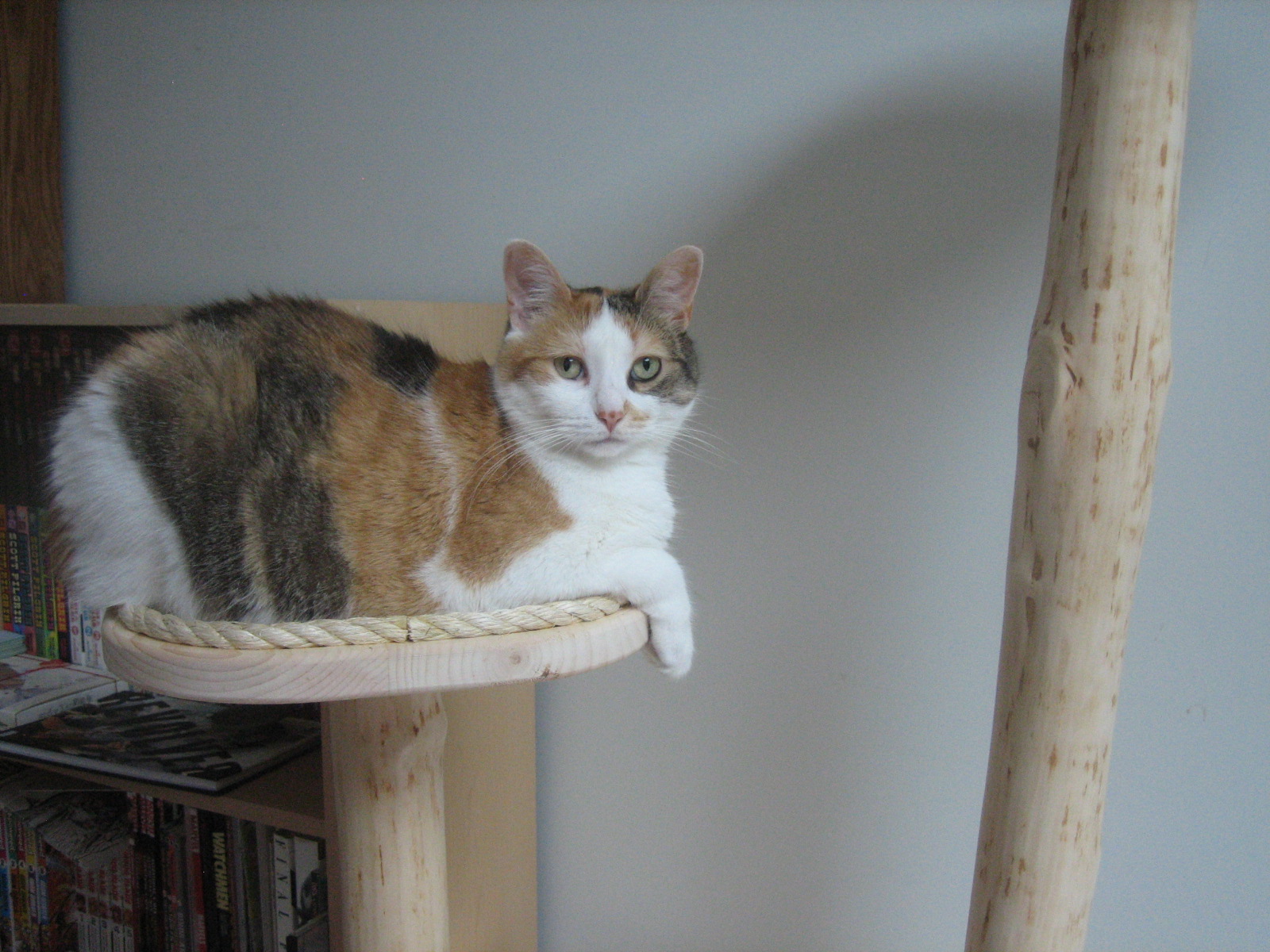
I had to wait a week for Milly to be brave enough to try it out, but as you can see here she's become quite fond of the middle platform. This is Mountain Cat Trees' 58" Three-Level Cat Tree, with platforms at heights of 22", 40", and 58" if you include the base. The posts are birch trunks with the bark removed and the base and platforms are made of textured pine. These trees were harvested after storms when it is easy to find downed trees in the forest, and the wood was treated with a non-toxic clear coat finish.


Putting the tree together was a simple, straight-forward process. The minimalist cardboard and kraft paper packaging was easy to remove and set aside for reuse. I had no trouble following the instructions and was done in about half an hour. I didn't need any tools besides a screwdriver and the enclosed Allan key.


Each platform is bordered with sisal rope. This lets cats really dig their claws in to the edges of the platforms when they reach up and use the edge to stretch. My hope is that the corners of the dining room table become less useful for the same purpose! The sisal scratching post that you can see in the first photo (leaning up against and screwed into the tall post) should also discourage my cats from using the back of the couch to sharpen their claws. Sisal gives them a stronger grip and doesn't feel anything like upholstery!


I'm still waiting for the day that Donut ventures onto the tree and Milly has the guts to scale the 58" high platform. I've been able to entice her up there with catnip, but she never stays too long. If there's one thing I know, it's that you can't force cats to do anything they don't want to, so I'm content to wait for now. I'm just glad that in the mean time, no toxic chemicals are leaching from the tree into the air and onto my cats!


Would you switch to eco-friendly furniture for your pet(s)?

Friday, July 15, 2011

Friday Feel Good News

It's Friday, and in my books, that means it's time to feel good. Let's set aside the doom-and-gloom stories for a moment and focus on some good news!

--------------------

This week I was happily surprised to hear that the Local Food Procurement Policy for the City of Toronto was not scrapped after all! A couple of weeks ago it was under threat when a consultant's report was released, stating that it was unrealistic to get the City to buy 50% of its food from local sources. When a compromise was suggested, that of targeting the policy at the departments that purchase food for child care centres, long-term care homes, and shelters, one Councillor went so far as to recommend the entire policy be scrapped. So this good news is actually great news, because the motion to keep the policy under these new terms was passed at 40 votes to 1! Please read this press released from Food Forward for more details:


Attention News/City Editors:

For Immediate Release

Thursday July 14, 2011


Council gives green thumbs up to local food

TORONTO, ON – Good news comes out of City Council’s third day this week as Councillors voted nearly unanimously to keep the City’s local food procurement policy, providing fresh food at City child care centres and long-term care homes.

“This is a win for the City’s food movement, the environment and Toronto food sector jobs,” said Darcy Higgins, Executive Director of Food Forward.  “In deciding to support local food, Council sends a clear message that it cares about local farms and healthier food for its residents.”

The policy, which began in 2008, had been at risk after a tie vote at Government Management Committee brought the matter to Council.  Over the last two weeks, letters and petitions from residents and cooperation by councillors on different sides of the political spectrum helped to return support for the policy.

“Over 58,000 people in Toronto are employed in the food sector, providing 1 in every 8 jobs, and this policy will continue to generate support for good work in this sector.” said Higgins. “Toronto residents and our members hope for continued support from this Council in recognizing the benefits of expanding food programs like urban agriculture and allowing community food projects and businesses to flourish.”

Food Forward especially thanks new Councillor Mary-Margaret McMahon and the Toronto Environmental Alliance for their work to support local food.

- 30 -

Contact:

Darcy Higgins
Phone: 416-459-9975

Wednesday, July 13, 2011

When Growing Your Own Food Is a Crime


Can you blame someone for putting vegetable beds in their front yard after it was torn up for sewer repairs? I wouldn't, but the city of Oak Park, Michigan, seems to think that's an appropriate action to take against a mother of six who refused to remove her garden. Julie Bass has now been ticketed, charged with a misdemeanour, and may face up to 93 days in jail if a jury finds her guilty on July 26th.

The five raised beds she uses to grow corn, squash, tomatoes, other veggies, and even some law-abiding flowers can be seen in a photo embedded in this article from Treehugger. Frankly, that garden looks tidier than many front lawns I've seen, but apparently Oak Park City Planners take offence at how unsuitable edible plants are for a front yard. It would seem "suitable" means "common", and if you want to keep up with the Jones' you plant grass, trees, and flowers, but no veggies - regardless of how well or poorly they are maintained. I guess small-minded city bureaucrats like the proverb about the nail that sticks out getting hammered down.

But we don't have to let this happen without putting up a fight. Here's what you can do:

  1. Call Oak Park city officials. Check out Julie's blog to find contact information for the Mayor, City Manager, and other officials. Remember that one phone call is worth about a dozen e-mails, so please call if you can.
  2. "Like" the Oak Park Hates Veggies Facebook page.
  3. Tell your Twitter followers and Facebook friends about this in the weeks leading up to the trial. There are many reasons to support Julie, not the least of which is outrage that a cash-strapped city would spend so much money on investigating, charging, and prosecuting such a harmless act. If it can happen in Oak Park, it can happen where you live. I wouldn't want my taxes to be wasted on something like this!

Imagine you move into a house with better growing conditions in the front yard than the back (due to differences in size, exposure to sunlight, soil drainage, etc.). Would you consider planting veggies out front rather than out back? Would you fight the City if they disapproved of your "unsuitable" choice of plants?


Photo used under Creative Commons from Scorpions and Centaurs (flickr).