Showing posts with label GHG emissions. Show all posts

Monday, December 12, 2011

Excuse Me While I Bang My Head Against the Wall

Sigh.

SIGH.

On days like today, I'm not even sure if "WTF!?" truly captures my reaction to the news. I need a new expression to reflect my complex emotional state after hearing that Canada has officially pulled out of the Kyoto Protocol. NDP Environment critic Megan Leslie put it best when she said, "it's like we're the kid who's failing the class, so we have to drop it before that happens", which as we know from our school days makes everything better.


I don't actually want to rant about this, since I don't want to make myself more miserable than I already am, so instead I'd like to draw your attention to the problem of air pollution in Beijing. Why? Because it gives us present-day proof of how screwed we are if we don't do something about the state of the environment. Last week, the smog in China's capital city was so bad that highways were closed and flights were cancelled because visibility was limited to a few hundred metres. The U.S. Embassy's smog index actually exceeded its upper limit. What's worse than a "hazardous" reading? Critical? Life-threatening? Deadly?

It saddens me that so many people have gotten caught up in debating the merits of measuring one particle vs. another (the Americans like the PM 2.5 standard, the Chinese like PM 10), not because it doesn't matter (it does), but because it detracts from the real problem: the air in northeastern China is a chronic and very dangerous issue. It's possible that breathing in that bad air will reduce life expectancy by five years. What are we going to do about it?


We can start by thinking about the main contributors to air pollution in the Beijing area: vehicles, coal-fired power plants, and industry. While China is on the other side of the planet, I actually feel quite capable of helping to bring about change in these areas by remembering the link between my actions and their consequences:

  • cars: I admit to owning one. However, it's very fuel-efficient, and I only drive it once or twice a week. If I had to give it up, I'd probably adjust pretty quickly, never look back, and roll around in all the money I'd be saving. The best part? I would be an excellent role model, showing how great my quality of life can be without having to own a car.

  • coal: I am a huge supporter of clean and renewable energy and its ability to reduce our dependency on fossil fuels, thereby mitigating climate change. The more we invest in mixing alternatives into the conventional electricity grid, the sooner we'll develop more efficient green power generation technologies, which will hopefully lead to the whole world turning to renewables.

  • stuff: I avoid buying useless crap, especially useless crap made in China. As for those items that are practical and necessary, I try to find the ones that are made domestically, and made without plastic (since so much of it comes from China). Our consumer culture is partially responsible for the dirty clouds billowing out of Chinese factories, and I want no part of it.

My lifestyle impacts my home and work; my city, region, province, and country; and in many ways, the whole planet. The Conservative government believes it is justified in shirking responsibility; I could not disagree more and refuse to allow this country's rapidly declining international reputation to smear my own.


Photo of F grade used under Creative Commons from amboo who? (flickr).
Photo of Beijing traffic used under Creative Commons from poeloq (flickr).

Wednesday, September 7, 2011

When environmentalism meets slow living... and they don't get along...

I am a letter-writer, hear me roar! Or hear the scrape of my fountain pen against paper, as it were...

This week I received a letter in the mail, one I had written and sent to Australia and which was subsequently returned to me because the recipient had moved and informed me of her new address only after the mail was already on its way to the other side of the world. And so a few pieces of paper and an envelope found themselves travelling 16,000 km (10,000 miles) only to be labelled with a "return to sender" scribble and sent back that same distance to my door. Let me tell you, a lot of guilt was delivered by mail that day!

Except... I'm not so sure. On the one hand, paper stationery kills trees, ink is made of petroleum and other toxic chemicals, and planes emit a great deal of emissions. On the other hand, even if I could stop using paper altogether for the rest of my life, forests would still die at the hands of big corporations and their printers' endless appetite for reams of paper, not to mention the pulp and lumber industries. Even if I gave up ball-point and fountain pens, every last drop of petroleum will eventually be extracted for fuel and military uses. And let's face it, there won't be fewer planes in the skies just because I stop mailing letters. The sad truth is that even if every last proud letter-writer like me gave up their hobby, not much would change on the global scale.

Unfortunately such rationalization doesn't make the guilt disappear. I still hold sustainability ideals close to my heart and feel the need to do as much as I can, within reason, to lessen my carbon footprint. The strange thing is that my desire to live simply and slowly occasionally gets in the way of my environmental goals, like in this case. Usually my attempts at taking breaks from the fast pace of life - cooking seasonal meals with locally grown ingredients at home, unplugging from the internet over the weekend, getting up early to walk all the way to work, etc. - conveniently satisfy my urge to live green. Writing letters, it seems, helps with the former and impedes the latter. Sitting down with a cup of tea in my left hand and a fountain pen in my right hand to share my recent life experiences with a far-away friend is a lovely experience, and not something easily accomplished using an electronic, environmentally friendly method. And so I sacrifice the planet ever so slightly for the sake of my well-being, which I hope is the right trade-off.

What do you do that lets you live slowly but isn't as green as you'd like?


Photo of fountain pen used under Creative Commons from Adrian Clark (a.drian/flickr).
Photo of air mail stickers used under Creative Commons from Katey Nicosia (flickr).

Wednesday, September 15, 2010

Watching the World Clock Makes Me Sad

Today I discovered Peter Russell's World Clock. If you watch it for about half an hour, you'll see the number of extinct species go up by one. I was too distracted by all of the other numbers (count-ups?) to notice this happening, however.

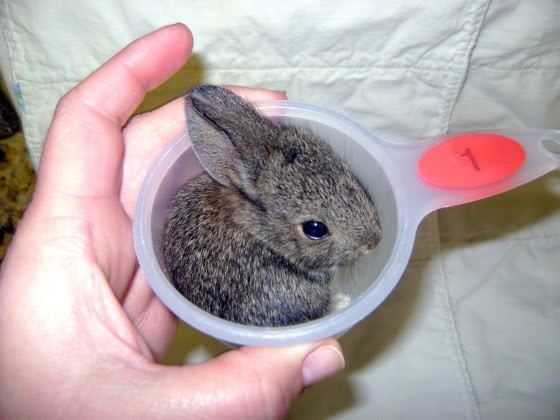
Folks, this is going to be a depressing post to read. I'll try to keep it short. Please enjoy this cute picture to bolster your spirits, then grab a box of tissues, and we'll hold each other as we examine this sadness together. Don't worry, I'll place another cute picture right at the end.

Bunny in a cup! Courtesy of http://cuteoverload.com

On the clock, the first statistic we face is the rapid growth of the population. Those numbers are going up so fast that if I count along with them out loud, I have to skip a few just to take a breath. It isn't pleasant, of course, to look at how often someone dies, but if you watch the "Death" counter you'll notice it's going quite a bit slower than the three other counters in that part of the clock. There are a lot of us on this little planet, and every day more of us are moving up in socio-economic status, leaving behind larger and larger footprints.

Next we're assaulted with that bleak statistic about species going extinct, as I mentioned above. One every half hour means 48 every day. Meanwhile, there are 1.5 billion cows on the planet (thankfully, there is no counter for bovine population growth on the clock). There's something wrong with this picture, right? Unsurprisingly, forests are being cut much faster than they're being replanted. Actually, reforestation is happening so slowly that it's even being outpaced by desertification. In other words, a double whammy of death. While clearcutting forests with modern machinery is pretty fast-paced work, desertification happens very slowly, doesn't make for good TV, and occurs in parts of the world the Western hemisphere prefers to ignore, so this doesn't make headlines too often.

Ah, the war budget, my favourite part of the clock! If only Peter Russell had also added a counter for how much money is being made from war, then we'd really be set. In less than one year, 850 billion dollars have been spent on the military, globally. Meanwhile, half of the world lives in poverty. What?!

Let's move on. I was prepared to feel sad, not angry.

Barrels of oil and tons of green house gases are being pumped and emitted, respectively, at approximately the same rate. I know it's not scientific of me to say this, but I can't help myself: "coincidence? I think not!" I know there are a lot of decimal points in the digital thermometer on the clock, but that's a good thing. Chances are you live close enough to sea level that a rate of climate change any faster than this would see you running for higher ground a lot sooner than you thought.

Some good news: bicycles are being made faster than cars (and computers). I'll be writing about the BIXI bike-sharing program in a future post, just you wait! The "Internet users" statistic is interesting because only recently has there been any media coverage about the amount of energy used to run a search, and these days it's so fashionable to look things up on the internet. I don't question the utility of finding an answer quickly, and I certainly wouldn't be able to update this blog with much frequency were it not for internet searches, but I wonder why we spend so much time on the internet doing brain-numbing things. What are celebrities wearing to TIFF screenings? I don't care!

For your sake and mine, I'm going to skip the abortions counter. I will also not delve deeply into the "Death Causes" column on the clock, because I promised a short post and have clearly already gone back on my word. Heart disease remains a bigger killer than cancer. Both are mostly preventable. Most of the deaths attributed to infectious disease are taking place in undeveloped nations - we can cure TB and leprosy, it's just not happening when there are no resources.

Okay, that's enough. I'm glad you stuck with me. As uncomfortable as it is to face the truth, we really have to at this point. Remember the World Scientists' Warning to Humanity? 18 years have gone by. Are we doing enough?

As promised, here is another cute picture to cheer us all up:

Piglet in pink rain boots! Courtesy of http://cuteoverload.com